
35 rounds · filed under dense · 34 of them
Home decor · added 15 Oct 2026
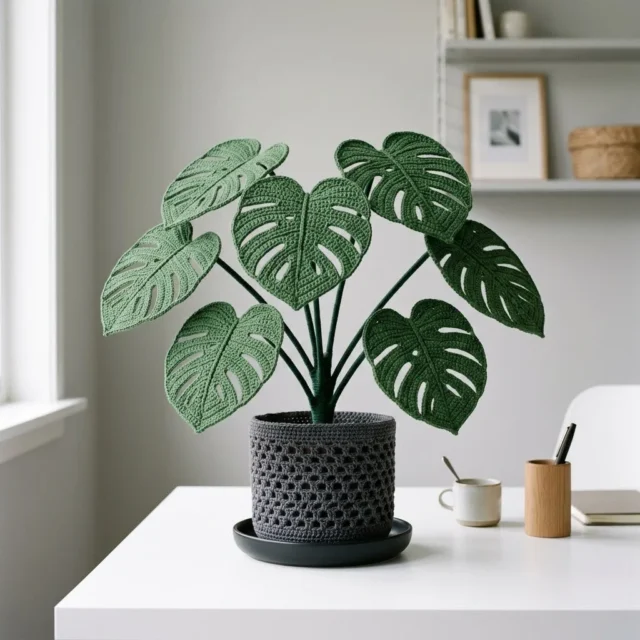
Crochet monstera leaf plant for your home office desk
Tight single crochet builds a firm, leaf-shaped fabric that holds its shape as a desk monstera plant.
- Skill
- Intermediate
- Time
- 4-6 hours
- Hook
- 4.0 mm
- Yarn
- Worsted
- Rounds
- 35
About this pattern
Single crochet worked at a tight gauge—16 stitches and 18 rows to 4 inches on a 4.0mm hook—turns cotton yarn into a fabric with almost no give. Each row pulls the next stitch close, so by the time the half double and double crochet sections widen the center, the whole piece already resists stretching. Pressed flat, it feels closer to stiffened canvas than typical crochet, which is exactly why a leaf this size can stand upright instead of flopping over a pot's rim.
Three identical leaves take shape from a straight foundation chain that widens through rows of mixed stitch heights, narrows through skipped-stitch notches at the sides, and tapers to a single point. Mount each one on a wire-filled stem cover, wrap the join in floral tape, and anchor the stems in a foam-filled pot. Arranged together, the leaves spread wide enough to fill a desk corner without needing water, light, or trimming back.
The swatch in numbers
- Rounds
- 35
- Parts
- 11
- Level
- Intermediate
- Time
- 4-6 hours
- Hook
- 4.0 mm
- Yarn
- Worsted
The yarn and the hook
- Green floral tape
- Wire cutters
- Yarn needle for weaving ends
- Stitch markers
- Small pot or crocheted pot cover (pattern included below)
- Floral foam or polystyrene block to fit inside pot
Optional
- fabric stiffener spray
- Stitches and Abbreviations Used
- Chain (ch): The foundation stitch. Yarn over, pull through the loop on your hook. This creates the base row or adds height.
- Single Crochet (sc): Insert hook into stitch, yarn over and pull up a loop (2 loops on hook), yarn over and pull through both loops. This is your most basic, tightest stitch.
- Half Double Crochet (hdc): Yarn over, insert hook into stitch, yarn over and pull up a loop (3 loops on hook), yarn over and pull through all 3 loops. Slightly taller than single crochet.
- Double Crochet (dc): Yarn over, insert hook into stitch, yarn over and pull up a loop (3 loops on hook), yarn over and pull through 2 loops, yarn over and pull through remaining 2 loops. Creates a taller, more open fabric.
- Slip Stitch (sl st): Insert hook into stitch, yarn over and pull through both the stitch and the loop on your hook in one motion. Used for joining and creating smooth edges.
- Single Crochet Decrease (sc2tog): Insert hook into first stitch, pull up a loop, insert hook into next stitch, pull up a loop (3 loops on hook), yarn over and pull through all 3. This decreases your stitch count by one.
- Gauge
- Work 16 sc and 18 rows = 4 inches in single crochet with 4.0mm hook using cotton yarn.
- Gauge matters here because you want a tight, firm fabric. If your leaves are too floppy, go down a hook size. The stiffness is part of what makes this plant look so realistic.
- Pattern Instructions
- Large Monstera Leaf (Make 3 in Dark Green)
Stitches, spelled out
ch chain; st stitch; sts stitches; sl st slip stitch; sc single crochetDense; hdc half double crochetDense; dc double crochetDrape; sc2tog single crochet 2 stitches together (decrease)Dense; sk skip.
Tension and hand-feel
Measure the first few rows of the center spine against 16 sc and 18 rows to 4 inches on a 4.0mm hook before moving into the shaping rows.
If the swatch comes out looser than that, drop to a smaller hook so the fabric stays firm enough to hold its leaf shape once the stiffener is applied.
Center Spine
Center Spine
Crocheted Stem Cover
Ch 4. Join with sl st to form ring.
Base
Building the Leaf Shape
Sides with Mesh Detail
Tapering to Point
Tapering
Rows 7 through 12: Continue decreasing at edges as established, reducing by 2 sts each row until 6 sts remain.
Hook
4.0mm (G/6) crochet hook
Chain (ch)
Single Crochet (sc):
Insert hook into stitch, yarn over and pull up a loop (2 loops on hook), yarn over and pull through both loops. This is your most basic, tightest stitch.
Half Double Crochet (hdc):
Yarn over, insert hook into stitch, yarn over and pull up a loop (3 loops on hook), yarn over and pull through all 3 loops. Slightly taller than single crochet.
Double Crochet (dc):
Yarn over, insert hook into stitch, yarn over and pull up a loop (3 loops on hook), yarn over and pull through 2 loops, yarn over and pull through remaining 2 loops. Creates a taller, more open fabric.
Slip Stitch (sl st):
Insert hook into stitch, yarn over and pull through both the stitch and the loop on your hook in one motion. Used for joining and creating smooth edges.
Single Crochet Decrease (sc2tog):
Insert hook into first stitch, pull up a loop, insert hook into next stitch, pull up a loop (3 loops on hook), yarn over and pull through all 3. This decreases your stitch count by one.
Skip (sk): Miss the indicated stitch and work into the next one. This creates intentional gaps.
Border Edging
Join yarn at base of leaf spine. Sc evenly around entire leaf edge, working 3 sc in each corner point and 1 sc in each row end along sides. Sl st to first sc. Fasten off.
How the texture is built
- The center spine starts flat from a straight chain of 30 (then 29 sc) rather than in the round, which keeps the leaf lying flat on a table instead of curling into a cup shape.
- Rows 3 through 5 place sc at the outer edges, hdc and dc moving toward the center, and a skipped-stitch ch-3 or ch-4 gap at the very middle — that gap is what opens the mesh notch along each side, the detail that reads as a monstera split.
- Sc2tog decreases appear only at the row ends (row 4's close, row 5's open), so the width loss is concentrated at the two edges while the center dc column keeps its height, producing the gradual taper to the leaf's point.
If you swap the yarn
| mercerized cotton, worsted weight | keeps the 4.0mm hook and the stated gauge, but the smoother fiber gives crisper stitch definition and lets the fabric stiffener spray soak in more evenly. |
|---|---|
| acrylic, worsted weight | produces a fabric with more drape and less natural body, so dropping to a 3.5mm hook helps hold the tight gauge the pattern calls for; the stiffener will need a second light coat to compensate for acrylic's softer hand. |
| cotton-linen blend, worsted weight | adds structure on its own, so a 3.75mm hook keeps the stitch count accurate while needing less stiffener spray overall; the resulting fabric feels drier and holds creases at the center spine without much pressing. |
Colorways
- Single-Shade Classic Work the center spine rows, shaping rows, mesh sides, and tapering-to-point rows all in one solid dark green; keep the stem cover in the same green so the wire and floral tape wrap disappear against the leaf base.
Washing and blocking
Spot clean with a damp cloth only; the fabric stiffener spray is not washable, and saturating the leaves in water will dissolve the stiffening and leave the sc fabric limp.
Reshape leaf tips and side notches by hand while the stiffener is still slightly tacky after application, pressing creases along the center spine so they set as it dries.
Store the piece flat or loosely upright in dry conditions away from humidity, since cotton treated with stiffener softens and curls again if kept damp.
When it does not look right
- the leaf lies curled rather than flat
- Stiffener was applied unevenly or the base fabric was worked too loosely; respray and press the leaf flat while damp, and go down a hook size if the sc rows measure looser than 16 sts to 4 inches.
- the mesh notch at the sides pulls closed instead of staying open
- The ch-3 or ch-4 space was worked too tightly or the skipped-stitch count drifted; recheck that the skip matches the chain length given and keep tension even so the gap stays open.
- the stem wobbles or bends near the base of the leaf
- The wire was not pushed fully into the stem cover or the floral tape was wrapped too loosely; seat the wire the full length of the spiral tube before fastening off, then wrap tape firmly from the stem into the leaf spine.
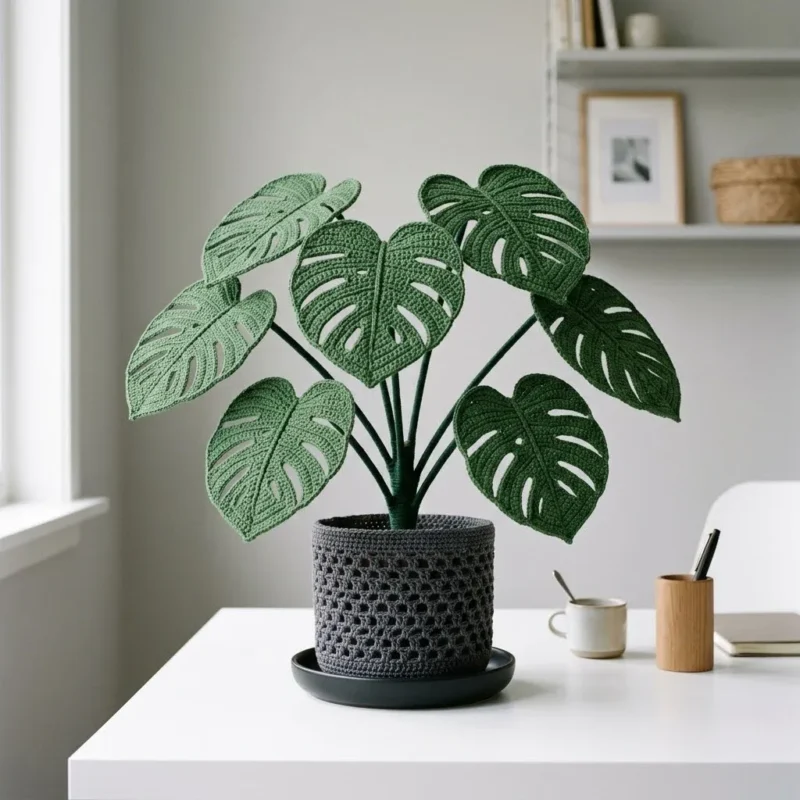
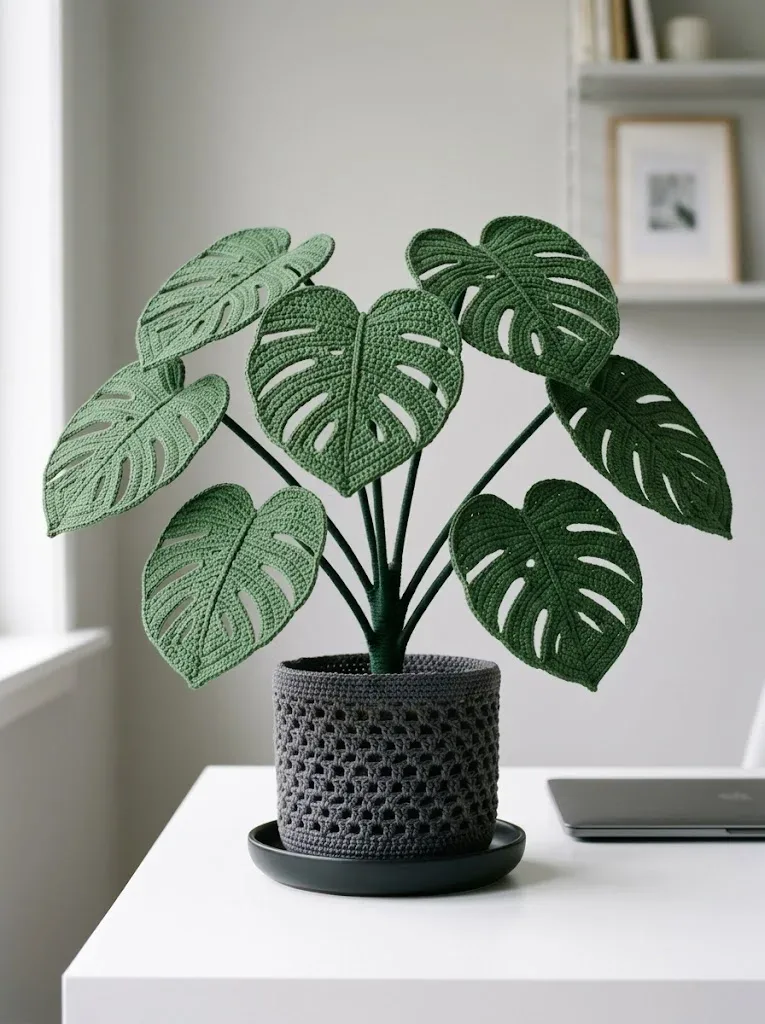
Close-ups
Questions people ask
Can the leaves be made in a lighter weight yarn?
Yes, but drop to a smaller hook than 4.0mm to keep the sc fabric dense enough to hold the fabric stiffener's shape. A looser, lighter-weight fabric will sag instead of standing upright in the pot.
Do all three leaves need to be identical?
The pattern repeats the same center spine, shaping, and tapering rounds for each of the three leaves, so working them the same way keeps the finished plant looking uniform. Making one slightly smaller just means shortening the starting chain and matching the shaping rows proportionally.
Is stuffing needed inside the leaves?
No, each leaf is a single flat panel stiffened with spray rather than a stuffed shape. The firmness comes from the tight sc gauge and the stiffener, not from fiberfill.
How is the leaf attached to its stem?
Wire is inserted through the crocheted stem cover tube, then stitched with a yarn needle to the base of the leaf's center spine. Any exposed wire is wrapped in green floral tape to hide the join.
New patterns, as they are filed
One short email when a batch lands, with the feel of each.