
8 rounds · filed under dense · 8 of them
Socks · added 20 Oct 2026
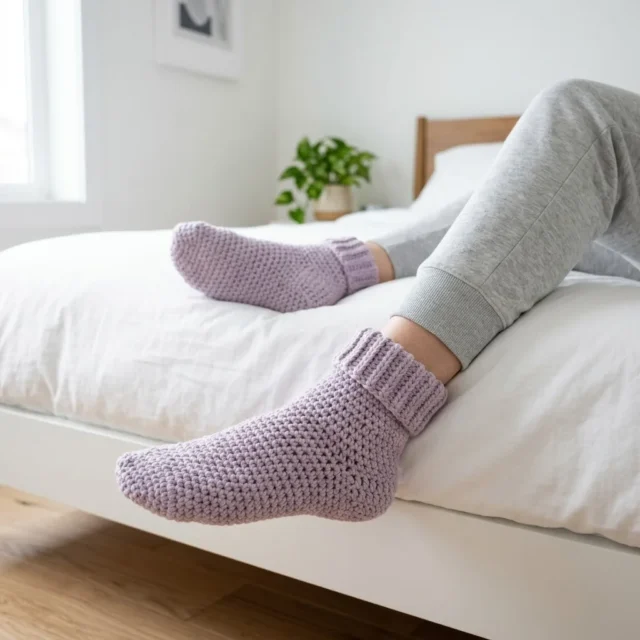
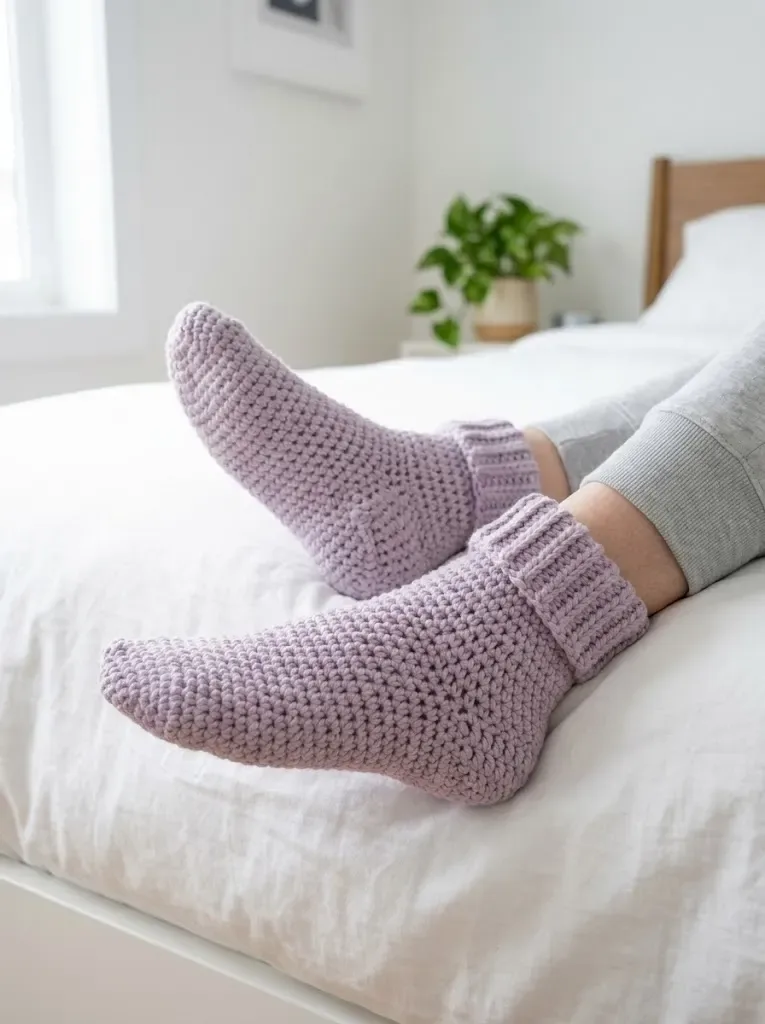
Lavender dream ankle socks in single crochet
Single crochet builds a dense, stretch-resistant sock fabric with a heel and ribbed cuff for ankle socks.
- Skill
- Intermediate
- Time
- 4-6 hours
- Hook
- 4.0 mm
- Yarn
- Worsted
- Rounds
- 8
About this pattern
Single crochet worked in continuous rounds gives this sock a tight, dense surface that resists stretching the way a knit sock would. At 18 stitches and 20 rounds to 4 inches, the fabric sits close to the foot rather than ballooning around it, so the stitch count has to be managed through decreases rather than relying on give. Run a thumb across the gusset area and feel the fabric firm up where the stitch count peaks before narrowing back down.
The shape comes together around a heel turn and a gusset that steps the stitch count down from a wider pickup round back to 36 stitches, shaping the foot to wrap the ankle rather than sit as a flat tube. With a ribbed cuff worked on a smaller hook to tighten the fabric at the top, the finished sock pulls snug at the ankle and holds its shape when worn with low shoes or on its own around the house.
The swatch in numbers
- Rounds
- 8
- Parts
- 6
- Level
- Intermediate
- Time
- 4-6 hours
- Hook
- 4.0 mm
- Yarn
- Worsted
The yarn and the hook
Yarn
- Approximately 150 yards of worsted weight yarn (weight category 4) per sock
- 300 yards total for the pair
- Sample shown in a soft lavender shade
Hook
- 4.0mm (US G/6) crochet hook for the main sock
- 3.5mm (US E/4) crochet hook for the ribbed cuff (optional, creates tighter ribbing)
Notions
- Stitch marker
- Tapestry needle for weaving ends
- Scissors
- Gauge
- 18 stitches and 20 rounds = 4 inches in single crochet worked in continuous rounds
Stitches, spelled out
ch chain; st stitch; sts stitches; sc single crochetDense; sc2tog single crochet 2 stitches together (decrease)Dense; rnd round; rnds rounds.
Tension and hand-feel
After the first few rounds of the pickup round, lay the work flat and measure 18 stitches across — they should span 4 inches, and 20 rounds of single crochet should also measure 4 inches top to bottom.
Pickup Round
This will feel like a lot of stitches. We will decrease back down to 36.
Gusset Decrease Rnds:
We are back to 36 stitches. The sock should now cup your heel nicely.
Cuff height
Total height from heel to top of cuff: 5 inches I will include notes for adjusting the length throughout the pattern.
Hook
4.0mm (US G/6) crochet hook for the main sock 3.5mm (US E/4) crochet hook for the ribbed cuff (optional, creates tighter ribbing)
Notions
Stitch marker Tapestry needle for weaving ends Scissors
Setting Up the Heel
Your last stitch of Rnd 38 marks your starting point. We will work the heel over the next 18 stitches, leaving the other 18 stitches unworked (these become the top of the foot, or instep).
Heel Row 1 (Right Side): Ch 1, turn. Sc in next 18 sts. Turn. (18 sts)
Heel Row 2 (Wrong Side): Ch 1, sc in next 18 sts. Turn. (18 sts)
Heel Rows 3-14: Repeat Row 2. You now have a heel flap that is 14 rows tall.
Turning the Heel
This is where we create the cup shape. Stay with me, it is easier than it sounds!
Turn Row 1:
You have created a small cup shape. Now we pick up stitches along the sides of the heel flap and rejoin to work in the round.
How the texture is built
- The gusset decreases are placed on either side of an 18-stitch instep panel, with sc2tog worked just before and after that panel on each round, so the shaping pulls in symmetrically around the foot rather than skewing to one side.
- The stitch count drops in pairs each round of the gusset decrease (42, then 40, then 38 stitches), stepping down toward a 36-stitch total rather than dropping all at once, which keeps the single crochet fabric from puckering at the sides.
- The heel is turned as a separate stage from the gusset pickup, which lets the heel fabric build its own shaping before the gusset stitches are picked up around it and merged back into continuous rounds.
If you swap the yarn
| Acrylic-nylon blend, worsted weight | Matches the recommended fiber content closely, keeps the same 4.0mm hook and gauge, and holds up to repeated washing without the fabric going limp. |
|---|---|
| Superwash wool blend, worsted weight | Adds more natural stretch to the single crochet fabric, which can make the gusset decreases feel less rigid, though the cuff will relax faster between washes. |
| Cotton blend, DK weight | Produces a thinner, less elastic sock fabric; drop to a 3.5mm hook throughout to bring the gauge back toward 18 stitches per 4 inches. |
Colorways
- Tonal lavender Work the foot and gusset in the lightest lavender, then shift to a deeper violet for the heel turn and ribbed cuff so the shaping stands out against the plain single crochet.
- Contrast heel and cuff Keep the main foot and instep in a pale gray, and work the heel turn and ribbed cuff in a saturated plum so both structural parts of the sock read as a distinct band.
Washing and blocking
Hand wash in cool water and avoid wringing the dense single crochet fabric, since twisting can distort the gusset shaping.
Lay flat to dry rather than hanging, so the ribbed cuff does not stretch out of its tighter gauge under the weight of wet yarn.
Store folded rather than balled up, keeping the heel turn uncreased so the sock sits back into its shape the next time it is worn.
When it does not look right
- The gusset area puckers or cups instead of lying smooth around the foot.
- The sc2tog decreases on either side of the instep panel were likely worked unevenly; recount the 18 instep stitches each round to keep the decreases symmetrical.
- The heel turn sits off-center from the gusset pickup.
- The stitch marker placement likely drifted during the heel shaping; mark the center heel stitch before picking up gusset stitches so the two sides line up evenly.
Close-ups

Questions people ask
Why does the stitch count change so much through the gusset?
The gusset starts wide after the pickup round and narrows through paired sc2tog decreases on each round, moving from 42 stitches down to 36. This step-down shapes the fabric around the ankle instead of leaving it boxy.
Can the ribbed cuff be worked on the same hook as the rest of the sock?
Yes, but the cuff will come out looser since the 3.5mm hook is what tightens the ribbing. Using the same 4.0mm hook throughout gives a softer, less snug cuff.
How much yarn is needed for one sock versus the pair?
Each sock takes approximately 150 yards of worsted weight yarn, so a full pair needs about 300 yards total. Buy with a little extra if substituting a yarn with different yardage per skein.
Is the heel turned before or after the gusset stitches are picked up?
The heel is turned first as its own stage, then the gusset stitches are picked up around it and merged back into the continuous round. This keeps the heel shaping distinct from the gusset decreases that follow.
New patterns, as they are filed
One short email when a batch lands, with the feel of each.