
7 rounds · filed under lace · 3 of them
Home decor · added 29 Sep 2026
A reversible granny square cover for your cushion
Double crochet shells build a thick, corner-heavy granny square that folds into a reversible cushion cover.
- Skill
- Intermediate
- Time
- 4-6 hours
- Yarn
- Worsted
- Rounds
- 3
About this pattern
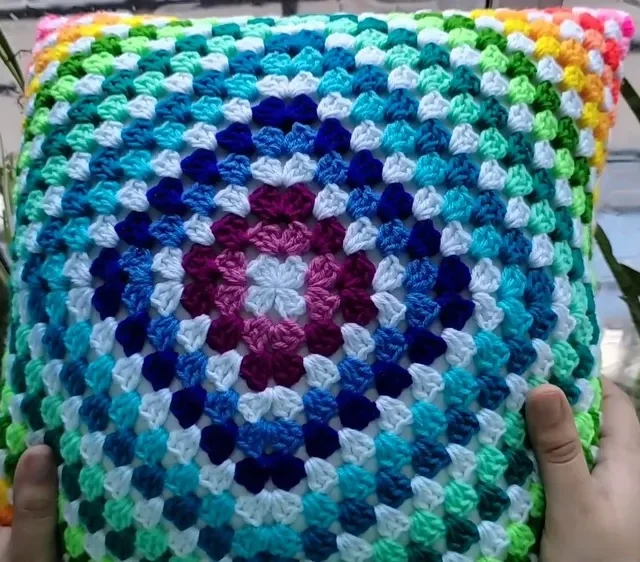
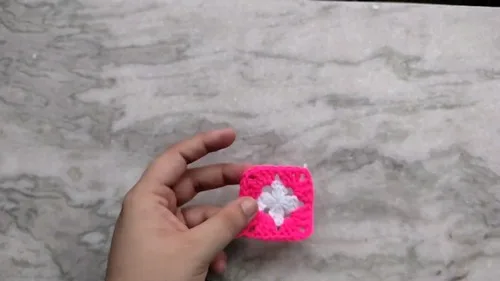
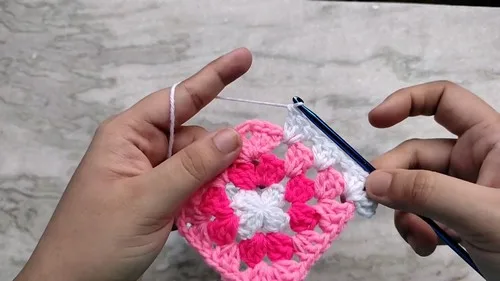
Under the hand this square sits thick and a little bumpy, never flat and smooth. Each round is built from double crochet shells — clusters of three stitches packed tight — so the surface ridges up between the chain-2 corner gaps, giving the whole piece a raised, tactile grid. It has body and resistance rather than stretch, more like a woven mat than a soft blanket square, and the color joins at each round add a faint ridge of their own where the yarn changes.
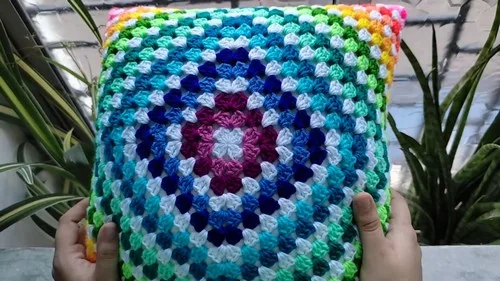
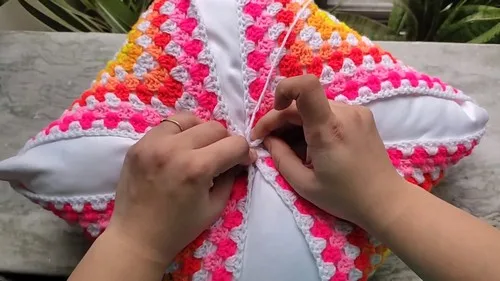
The shape starts as a tight center and fans out into a diamond-cornered square, wider than it is tall until you turn it so the corners point up, down, and out to the sides. Once it grows past the cushion's diagonal, that same square gets placed on point over the cushion, its four corners pulled up and in to meet at the center back, then sewn together there so both grid faces stay visible from either side.
The swatch in numbers
- Rounds
- 3
- Level
- Intermediate
- Time
- 4-6 hours
- Yarn
- Worsted
The yarn and the hook
- Yarn of various colors
- Crochet hook (size not specified)
- Cushion to cover
- Scissors
- Measuring tape
Stitches, spelled out
shell shell stitchLace.
Main Pattern
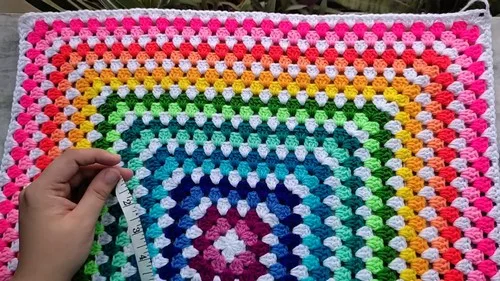
Measure the diagonal of your cushion (example given: 19 inches).
The side of your granny square should be slightly less than the cushion's diagonal (example given: 18.5 inches).
Putting the pieces together
Close-ups
Questions people ask
How do you know when the granny square is big enough for the cushion cover?
Measure the cushion's diagonal first, then keep working rounds until the square's side is slightly less than that diagonal figure. A square with an 18.5-inch side, for example, fits a cushion with a 19-inch diagonal.
Why does the cushion go in diagonally rather than straight?
Placing the cushion on point lines its edges up with the square's own corner-to-corner shells, so when the four corners get pulled to the center, they meet at a single seam on the back rather than bunching unevenly.
Can a round be left open instead of joined before starting the next color?
No, each round is worked in a closed loop and joined with a slip stitch before the next color goes on. Skipping the join would leave a gap in the shell pattern where the color change happens.
What is the long tail at the seam actually for?
It leaves enough yarn to unpick the sewn seam later, take the cover off the cushion for washing, then sew it back together afterward. Without that extra length, removing the cover would mean cutting the seam instead of just undoing it.
New patterns, as they are filed
One short email when a batch lands, with the feel of each.