
10 rounds · filed under dense · 6 of them
Amigurumi · added 15 Sep 2026
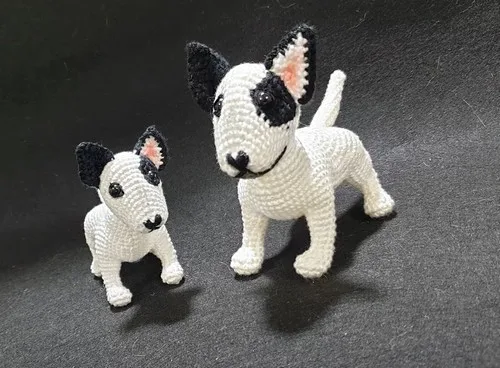
Crochet a Bull Terrier amigurumi with firm single crochet fabric
Single crochet builds a dense, leathery fabric for this stuffed Bull Terrier amigurumi, shaped as one continuous head-and-body piece.
- Skill
- Intermediate
- Time
- 4-6 hours
- Hook
- 1 mm
- Yarn
- Worsted
- Rounds
- 6
About this pattern
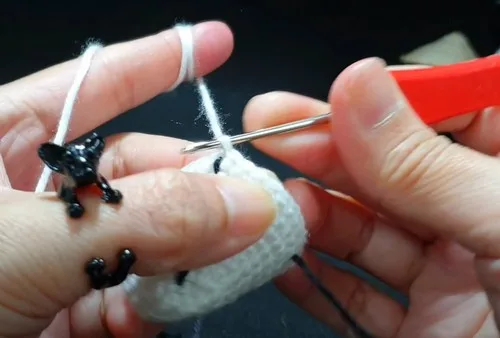
Single crochet built in a tight, joinless spiral gives this Bull Terrier amigurumi a dense, almost leathery hand — no gaps between stitches, so stuffing stays put and the surface reads smooth rather than fuzzy. Every round starts from a magic circle pulled snug, and because the hook works consistently into the same loop round after round, the fabric holds a firm curve without curling at the edges. Under your fingers it feels closer to felt than to a soft blanket stitch, sturdy enough to hold the shape a toy needs to keep.
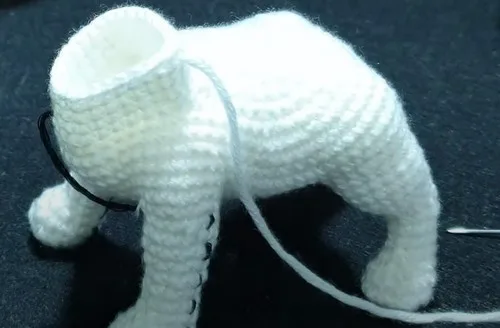
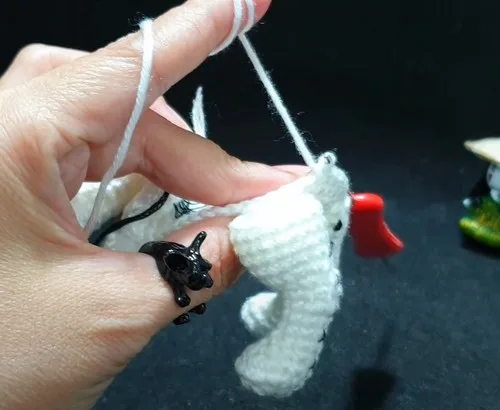
The head and body grow as one continuous piece, shaped entirely by where the increases fall and where the legs get tucked into the seam at round four. That single-piece construction means no side seam splits the torso — the shaping happens invisibly inside, at the leg attachment points instead. Once the shell is stuffed firm, the ears and tail — each grown separately from their own magic circle — get sewn on, and the wire threaded through the neck lets the finished head turn instead of sitting locked in place.
The swatch in numbers
- Rounds
- 6
- Parts
- 3
- Level
- Intermediate
- Time
- 4-6 hours
- Hook
- 1 mm
- Yarn
- Worsted
The yarn and the hook
- Two types; 1 mm thick for a smaller puppy (10 cm including ears) and 2 mm thick for a larger puppy (12 cm including ears).
- Suitable for chosen yarn size.
- Marker yarn, stuffing material, sewing needle, buttons for eyes (1.5 cm), and a piece of wire approximately 20 cm for attaching parts.
- Milk glue for stiffening parts.
Stitches, spelled out
sc single crochetDense; inc increase.
Tension and hand-feel
After round 3 the head-and-body piece should measure out to a flat, slightly domed circle of 18 single crochet stitches lying evenly, not cupped or ruffled.
If the round cups inward, drop to a smaller hook so the stitches tighten; if it ruffles or ripples at the edge, go up a hook size so the fabric relaxes.
Head and Body (worked as one piece)
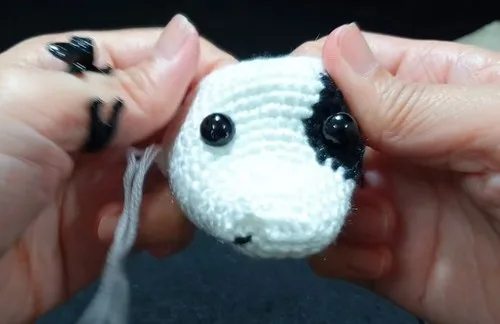
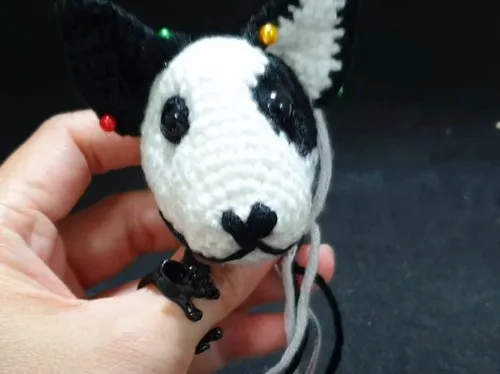
Remember to switch to black yarn for eyes and snout details.
Tail
Ears (make 2)
For Round 1: Create a magic circle with 6 sc stitches. (6)
Use white yarn for the main part and pink for the inner detailing.
How the texture is built
- Rounds 2 and 3 double the stitch count evenly, 6 to 12 to 18, building a flat, symmetrical base before any shaping starts — standard amigurumi math that keeps the crown from puckering.
- Round 4 breaks that symmetry on purpose: 8 sc, 6 sc, 7 sc, and 4 sc separate the four leg attachment points unevenly, widening the belly and chest on one side more than the other rather than working a perfectly round tube.
- The tail is worked as a plain cylinder on its own and only joined to the body between rounds 10 and 11, after the main shell is already shaped — so it reads as an applied piece stitched on, not grown out of the body itself.
Putting the pieces together
If you swap the yarn
| Cotton, worsted weight | Stitches lock down tighter and the surface gets a matte, slightly stiff hand, so the head-and-body shell holds its shape with less stuffing pressure; pairs with the pattern's 2 mm-thick option and matching hook for the 12 cm size. |
|---|---|
| Acrylic, sport weight | Produces a lighter, smaller shell closer to the pattern's 10 cm option; the fabric drapes more, so stuff firmly at the round 4 leg attachment points to stop them from sagging. |
| Wool-blend, fingering weight | Gives a softer, warmer hand but a looser stitch, so ears grown from the round 1-2 magic circle will flop rather than stand; drop a hook size to keep the spiral tight enough to hold stuffing. |
Washing and blocking
Hand wash the finished toy in cool water only, since the button eyes and any milk-glue stiffening on the ears won't hold up to a machine cycle.
Reshape the ears and muzzle while still damp, pressing them into the curve set by the increase rounds before they dry.
Store the toy stuffed and upright rather than folded, so the tight single crochet fabric doesn't crease at the neck or leg attachment points.
When it does not look right
- The head wobbles or won't turn smoothly on the body.
- The 20 cm wire wasn't seated deep enough through the neck before closing the last rounds; reopen the join and push the wire further into both the head and body before securing.
- The legs sit crooked or uneven on the finished body.
- The stitch counts separating them in round 4 (8 sc, 6 sc, 7 sc, 4 sc) got miscounted; unpick back to round 4 and recount each segment before attaching the legs again.
- The ears fold over instead of standing up.
- No milk glue was worked into the fabric while it was still shapeable; brush glue into the finished ear rounds, press into the curve, and let it dry fully before attaching.
Close-ups
Questions people ask
Should you make the 10 cm or 12 cm version?
That's decided by yarn thickness: the pattern's 1 mm-thick option gives the smaller 10 cm puppy including ears, and the 2 mm-thick option gives the 12 cm version. Pick the thickness first and match your hook to it before starting the magic circle.
How are the button eyes attached?
The buttons, sized at 1.5 cm, are sewn on with a sewing needle through the dense single crochet fabric at the designated rounds, which holds them firmly against the stuffing. Because they're sewn rather than snapped in, this construction isn't intended for infant toys.
When exactly does the tail get added?
The tail is worked as its own small cylinder, stuffed, and then stitched to the body between rounds 10 and 11 of the head-and-body piece, well after the main shaping is finished. Attaching it this late keeps it from distorting the increases lower down.
Is the milk glue on the ears necessary?
No, it's listed as optional stiffening. Skip it for a softer, more pliable ear that folds naturally, or apply it while the ear is still damp if you want it to hold a fixed curve.
New patterns, as they are filed
One short email when a batch lands, with the feel of each.