
63 rounds · filed under dense · 60 of them
Amigurumi · added 1 Oct 2026
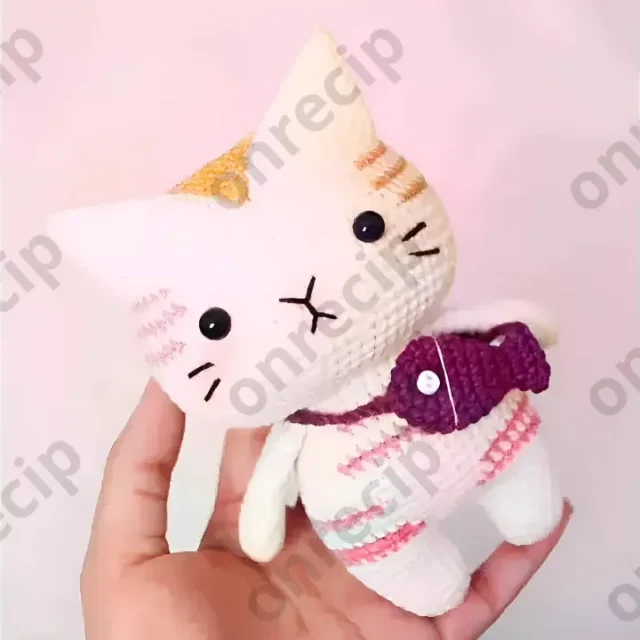
Crochet cat with a fish bag companion toy
Single crochet builds a dense, firm-bodied cat amigurumi with ears, legs, arms, and a tiny matching fish bag.
- Skill
- Intermediate
- Time
- 6-9 hours
- Hook
- 2.5 mm
- Yarn
- Fingering
- Rounds
- 63
About this pattern
Single crochet carries almost the entire piece, round after round with no gaps between stitches, so the head, body, ears, and legs all come out dense and firm rather than loose or lacy. At a 2–2.5 mm hook on thin cotton or acrylic yarn, the fabric tightens further, closing in around the stuffing so none of it shows through and the surface holds a crisp, closely packed texture under the fingers rather than a soft, open one.
The body builds up from a long oval base into a rounded standing cat, with the head's color-blocked round giving it a defined face before the ears and legs attach separately. A matching fish-shaped bag works up on its own and is meant to sit in or hang from the paws once the button and safety eyes are set, so plan the stuffing firmness of the body before attaching the smaller pieces, since a softer body will shift once the bag is added.
All parts of the cat are crocheted in a spiral unless otherwise noted. The body's stripes can be worked in jacquard crochet as you go, or embroidered onto the finished piece afterward. Cheeks are toned with dry pastel or blush, eyes can be safety eyes or half-beads, and the nose and whiskers are embroidered with black thread; the fish's eye is a small sewn-on button.
Difficulty level: Intermediate.
The swatch in numbers
- Rounds
- 63
- Parts
- 6
- Level
- Intermediate
- Time
- 6-9 hours
- Hook
- 2.5 mm
- Yarn
- Fingering
The yarn and the hook
- Cotton or acrylic yarn: white, gray, blue, black
- Hook 2–2.5 mm
- Safety eyes for toys
- Stuffing
- Stitch markers
- Pins
- Decorative button
- Dry pastel or blush
- Needle for sewing parts
- Scissors
Stitches, spelled out
KA magic ring; sl st slip stitch; ch chain stitch; sc single crochetDense; inc increase; dec decrease; (…) x n repeat n times.
Tension and hand-feel
After round 2 of the head, count for 40 sc around the oval base; if the stitch count comes up short or the edge ripples instead of lying flat, the tension is too loose for the 2–2.5 mm hook and a smaller hook will bring it back in line.
Check the ears the same way after round 4 (11 sc) — the cap should curve gently rather than pucker, which tells you the fabric is behaving before you commit to the longer head and body rounds.
Head
Alternate between white and gray yarn. White yarn for regular text, gray yarn for highlighted text. Begin with a chain of 15 ch (3 ch with white yarn, 9 ch with gray yarn, 3 ch with white yarn), and start from the second ch from the hook.
Ears (2 pieces)
Make 2Crochet with white yarn.
Legs (2 pieces)
Make 2Crochet with white yarn.
Body
Continue from the second leg and crochet 3 ch.
Arms (2 pieces)
Make 2Crochet with white yarn.
Do not stuff the arms. Sew them to both sides of the body.
Fish Bag
Do not stuff the fish bag, flatten the tail of the fish and sew along both sides. Attach the fish bag to the body.
Make a chain of 40 sc, sl st to the head of the fish. Attach a button for the fish's eye.
Your crocheted cat with a fish bag is now complete! Please mention the author @hainchan if you share it on social media.
Author: @hainchan. Enjoy!
How the texture is built
- The head starts from a chain of 15 worked around both sides (3 ch white, 9 ch gray, 3 ch white) rather than a magic ring, which is what gives the lower face its flattened, elongated width and centers the gray section as a marking instead of a stripe.
- Round 2 of the head places increases unevenly — a pair at the start, more scattered through the gray section, and more again near the end — so the muzzle and tip widen faster than the sides, building an asymmetrical shape instead of a round ball.
- The legs increase every round for the first three rounds (6, 12, 18) and then run plain through rounds 4–6, so all the shaping sits in the base and the rest works up as a straight tube; they are left unstuffed and sewn flat to the body rather than stuffed round.
If you swap the yarn
| DK weight cotton | Produces a firmer, more defined stitch with a slightly larger finished Head and Body; move up to a 2.5–3 mm hook, and the stiffer cotton needs less stuffing to hold its shape. |
|---|---|
| Fingering weight acrylic blend | Keeps the toy small and dense; use a hook near the 2 mm end of the range, pack stuffing more firmly to fill the smaller cavity, and expect finer, crisper Ear detail. |
| Worsted weight chenille or velvet-style yarn | Gives a plush, low-drape surface that softens stitch definition, so the Head's color blocking reads less crisp; stuff generously since the loft hides small gaps, and size up the hook slightly to match the thicker strand. |
Colorways
- Classic white-and-gray White carries the Body and the outer sections of the Head; gray is reserved for the Head's center panel and both Ears; black stays limited to eye and nose detailing; blue is worked only into the Fish Bag.
- Gray-forward Gray becomes the dominant color for the Body and most of the Head, with white pulled back to the Head's center strip and the Leg tips; blue runs through the Fish Bag and a contrast round on the Ears; black stays limited to the eyes.
Washing and blocking
Spot clean with a damp cloth rather than submerging the whole piece, since the safety eyes and the decorative button are not built for soaking.
If a deeper clean is needed, handwash in cool water, press the water out without wringing, reshape the stuffed rounds while still damp, and dry flat away from direct heat.
Store the piece stuffed rather than flattened so the dense single crochet fabric keeps its rounded shape, and keep it away from damp storage so the cotton or acrylic fibers don't mat.
When it does not look right
- The head's muzzle curls under instead of sitting flat.
- The increases on rounds 1–2 of the oval base are too tight or bunched in one spot; ease the tension on those two rounds and spread the increases evenly before moving into round 3.
- The ears flop instead of holding their slight cup.
- The increases are stacking in the same position every round; offset each round's increase from the one before it so the cap curves instead of pointing.
- The legs flare outward instead of staying a straight tube.
- Stitches are still increasing past round 3; stop increasing once the count reaches 18 sc and recount at the start of rounds 4–6 before continuing.
Questions people ask
Do the legs need stuffing before they're attached?
No. The pattern specifically leaves them unstuffed and has you sew them flat to both sides of the body, so they hold a soft, collapsed shape rather than a round one.
Why does round 1 of the head use both sides of the chain?
Working around both sides of a 15-ch instead of starting from a magic ring is what creates the oval base for the head, giving it an elongated muzzle width rather than a round start.
Can the Fish Bag be made in a color other than blue?
Yes. It's a separate piece from the Head, Body, Ears, and Legs, so swapping its yarn color doesn't affect the construction or gauge of the rest of the toy.
How much of each color is needed?
The materials list names the colors — white, gray, blue, black — but doesn't give yardage per color. The Head and Body use the most white and gray, the Ears and Fish Bag use smaller amounts, and black is only needed for eye and nose detailing, so keep extra on hand for finishing touches.
New patterns, as they are filed
One short email when a batch lands, with the feel of each.