
8 rounds · filed under drape · 2 of them
Accessories · added 27 Sep 2026
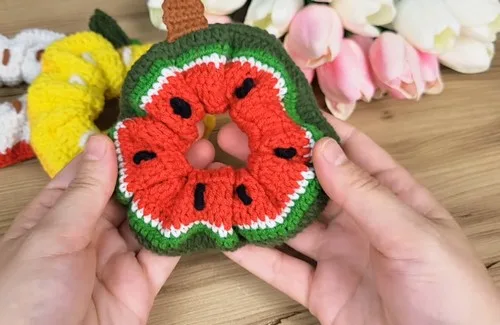
Crochet fruit scrunchie pattern with a stitched-on stem
Double crochet and half-double crochet ridges build a thick banded fabric that folds into a fruit-shaped scrunchie.
- Skill
- Intermediate
- Time
- 4-6 hours
- Yarn
- Worsted
- Rounds
- 4
About this pattern
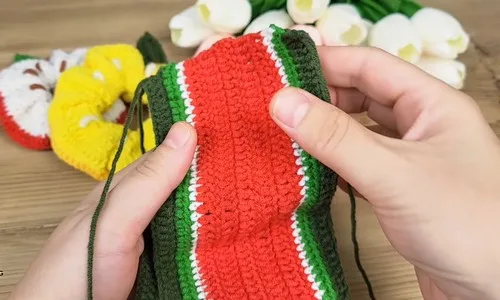
Four rows repeat across the same 100-stitch base, and each one uses a different stitch height: double crochet, then half-double, then single, then double crochet again. That shift stacks taller ridges next to a tight, low band, so the fabric reads as textured stripes rather than a flat plane. The single crochet row pulls in firmly, giving your fingers a ridge to catch on between the looser double crochet bands. Handled flat, the piece feels dense and structured, with body that holds its shape instead of draping loosely.
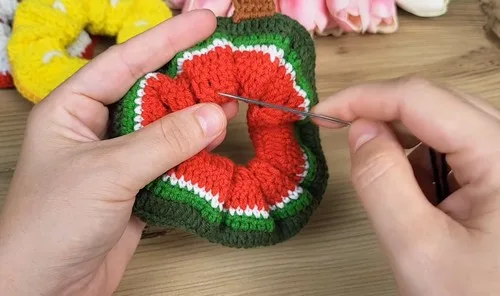
Once the four rows are done, you have a long rectangle rather than a finished shape. Folding it lengthwise and sewing the long edges turns that rectangle into a tube, and slipping a hair tie inside before closing the short ends gathers it into a rounded, fruit-like scrunchie. The brown stem stitched to the top finishes the shape, giving the gathered tube a small stalk that reads as fruit rather than a plain hair band.
The swatch in numbers
- Rounds
- 4
- Level
- Intermediate
- Time
- 4-6 hours
- Yarn
- Worsted
The yarn and the hook
- Worsted weight yarn
- Crochet hook (size to suit your yarn)
Stitches, spelled out
sc single crochetDense; hdc half double crochetDense; dc double crochetDrape.
Tension and hand-feel
After the first double crochet round, check that the 100 stitches sit at a width you're comfortable carrying through the remaining rows, since the pattern gives no set measurement to hit.
Main Pattern
You will now have a long rectangular piece of fabric.
Finishing the Main Fruit Piece Fold the crocheted piece in half lengthwise with the red side facing inward.
Using a yarn needle and the green yarn , sew the two long edges together to create a tube.
Turn the piece right-side out and insert a hair tie into the center.
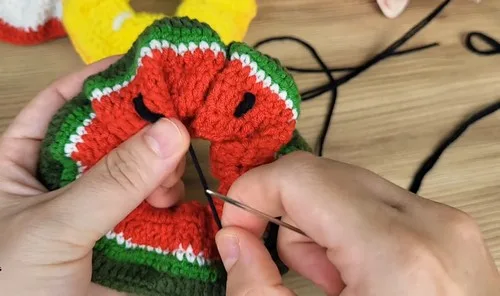
Sew the short ends of the tube together around the hair tie to form a scrunchie.
How the texture is built
- All four rows are worked flat across the same 100-stitch base chain rather than joined into rounds, so the piece stays a rectangle right up until it is folded and sewn during assembly.
- Stitch height changes row by row (dc, hdc, sc, dc) while the stitch count holds steady at 100 throughout, so the ridged texture comes from stitch height rather than any increase or decrease.
Putting the pieces together
If you swap the yarn
| Mercerized cotton, worsted weight | Firmer, less springy fabric with crisper stitch definition on the dc and hdc rows; use the same hook, and the finished tube holds its round shape around the hair tie with less give. |
|---|---|
| Acrylic, worsted weight | Closest match to the pattern as written, with a lighter, springier band and easier machine washing; hook size stays as given. |
| Wool-blend, bulky weight | Fewer stitches would be needed to reach the same width, so stitch counts would need scaling down; move up to a larger hook, and expect a thicker, softer tube with more loft. |
Colorways
- Classic apple Green on the foundation chain and the first double crochet row, white on the single crochet row, red on the final double crochet row, with a brown stem sewn at the top.
- Green pear Green carried through the foundation chain and both the double crochet and half-double crochet rows for a solid body, white kept as the thin single crochet band, red left out and a brown stem set at the top.
Washing and blocking
Hand wash in cool water and avoid wringing, since the alternating dc, hdc, and sc rows can distort if twisted while wet.
Lay the scrunchie flat to dry so the tube keeps its round shape instead of drying with a crease along the seam.
Store it looped loosely rather than stretched around a bulky item, so the sc band keeps its tight, ridged pull.
When it does not look right
- The rectangle curls at the edges instead of lying flat before folding
- The tighter single crochet row is pulling in more than the taller dc and hdc rows around it; steam the piece lightly or block it flat before folding and sewing.
- The finished scrunchie sits loose and doesn't gather around the hair tie
- The sewn tube is wider than the hair tie needs; take a deeper seam along the long edges or use a smaller hair tie so the fabric bunches properly.
Close-ups
Questions people ask
What size hair tie fits inside the tube?
The pattern doesn't specify elastic size, but a standard hair tie fits comfortably since the tube's width is set by the 100-stitch hdc row. If your fabric feels loose after sewing the seam, a smaller hair tie will gather it more tightly.
Can the stitch order in the four rows be changed?
Yes, dc, hdc, and sc rows can be rearranged, but each swap changes the row height and therefore the ridge pattern across the fabric. Keeping a low stitch like sc between two taller rows is what gives the current banded texture.
Why does each row start with a different turning chain?
The chain 3, chain 2, and chain 1 at the start of each row match the height of the stitch worked in that row, so double crochet gets a taller chain than single crochet. This keeps the row edges even instead of pulling tight or gapping.
Does the brown stem need any stiffening?
No, the stem is a small crocheted piece whip-stitched to the top of the gathered scrunchie and holds its shape from the stitches alone. No wire or stuffing is called for.
New patterns, as they are filed
One short email when a batch lands, with the feel of each.