
33 rounds · filed under dense · 30 of them
Amigurumi · added 29 Sep 2026
Plush amigurumi bear worked in double-strand single crochet
Single crochet in doubled plush yarn builds a dense, spongy fabric for a stuffed bear with head, body, and arms.
- Skill
- Intermediate
- Time
- 4-6 hours
- Hook
- 4.0 mm
- Yarn
- Worsted
- Rounds
- 33
About this pattern
Worked in single crochet with two strands of plush yarn held together, the fabric comes out dense and close-napped, closer to a fitted seat cushion than a sweater. Single crochet locks each stitch tight against the next, so there are no gaps for stuffing to peek through, and the doubled strand doubles down on that coverage, giving the surface a soft, brushed hand once the fibers bloom.
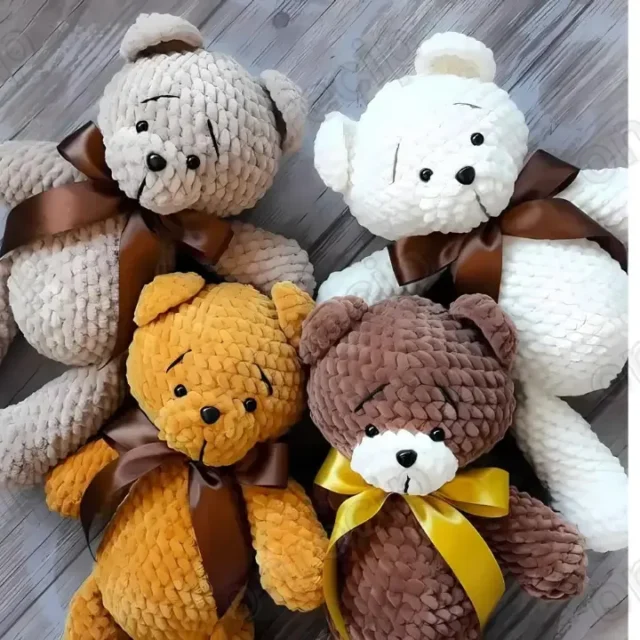
The finished shape is a rounded head, a slightly larger rounded body, and two short arms, each built as a solid sphere or near-sphere from a ring outward. Stuff each part firmly as you close it, then set the toy eyes and sew the pieces together so the head sits square on the body and the arms hang at the sides.
Difficulty level: easy. Any plush yarn works for this amigurumi, such as Himalaya Dolphin Baby, YarnArt Dolce, or Alize Softy, held in two strands. The finished toy is about 30 cm tall.
The swatch in numbers
- Rounds
- 33
- Parts
- 3
- Level
- Intermediate
- Time
- 4-6 hours
- Hook
- 4.0 mm
- Yarn
- Worsted
The yarn and the hook
- Plush yarn Himalaya Dolphin Baby, YarnArt Dolce, or Alize Softy (in two strands)
- Hook 3.5-4.0 mm
- Toy eyes
- Stuffing for toys
- Satin ribbon for decoration
- Needle for sewing parts
- Scissors
Stitches, spelled out
ch chain; sc single crochetDense; inc increase; dec decrease.
Tension and hand-feel
After round 5 on the head, lay it flat and check that it measures out to a neat 30-stitch circle without cupping or flaring at the edge.
If the disc domes upward or ruffles at the rim, your tension is off for the doubled yarn: go up a hook size if it cups, down a size if it ruffles. The assembled bear should finish at about 30 cm tall.
Head
Body
Arms (2 parts)
Make 2How the texture is built
- the head and body, each round adds six stitches distributed evenly around the circle, which keeps the increases stacked in spiraling lines rather than clustered, so the resulting sphere curves smoothly instead of forming a hexagon.
- All three parts start the same way, from a 6-stitch ring worked into the second chain from the hook, which sets a consistent base diameter before each piece branches off into its own final round count.
If you swap the yarn
| Acrylic chenille, worsted weight, single strand | Gives a similar velvety surface with less bulk in hand; drop to a single strand and use the smaller end of the 3.5-4.0 mm hook range to keep stitches closed. |
|---|---|
| Cotton-acrylic blend, DK weight, held double | Produces a firmer, less fuzzy fabric with crisper stitch definition; the finished bear comes out smaller, so consider stuffing more lightly to keep the shape from feeling rigid. |
| Wool-blend, aran weight, single strand | Adds natural loft and a warmer drape, but wool grips the hook differently than plush yarn, so expect to size up slightly past 4.0 mm to match the original stitch count comfortably. |
Colorways
- Classic tan bear Work the head, body, and arms entirely in a warm tan, keeping every round the same color for an unbroken plush surface.
Washing and blocking
Hand wash the plush yarn body in cool water; the doubled strands trap water, so avoid machine agitation that could felt or mat the pile.
Lay flat to dry away from direct heat, reshaping the head and body by hand while damp so the rounds settle back into even circles.
Store the bear stuffed and upright rather than flattened under other items, since prolonged pressure can crush the brushed nap of the plush fabric.
When it does not look right
- The head or body cups inward like a
- The increase rounds are running tighter than the plain rounds; loosen tension slightly on inc stitches or move up half a hook size.
- The arm's straight section (round 4)
- Stitches are being worked into the back loop or gapped along the flat round; keep the same insertion point and tension used in the increase rounds so the cylinder stays even.
- Stuffing shows through as small bumps
- The doubled strand has thinned in spots from uneven tension; pull stitches snug as you go, or add a lighter, more even layer of stuffing rather than a few dense clumps.
Questions people ask
Why does the pattern use two strands of plush yarn instead of one?
Holding two strands together thickens the fabric and closes any small gaps between stitches, which keeps the stuffing from showing through the plush surface. It also gives the bear a firmer, more huggable feel than a single strand would.
Can the arms be made without the sweater color change?
Yes, the color change at row 7 is only needed for the sweater version; working all 6 rounds in one color gives plain matching arms. The stitch counts and shaping stay the same either way.
How much should each part be stuffed before closing?
Stuff firmly enough that the plush fabric feels solid and holds its round shape without denting under light pressure. Underfilled parts will look soft and lose the sphere shape the increase rounds are built to create.
Does the hook size matter much with plush yarn held double?
Yes, within the 3.5-4.0 mm range, the smaller end keeps stitches tighter and better at hiding stuffing, while the larger end makes the fabric a bit more pliable. Test a swatch at round 5 of the head to see which end of the range matches your tension.
New patterns, as they are filed
One short email when a batch lands, with the feel of each.