
5 rounds · no stitch in the table, so unfiled
Amigurumi · added 4 Oct 2026
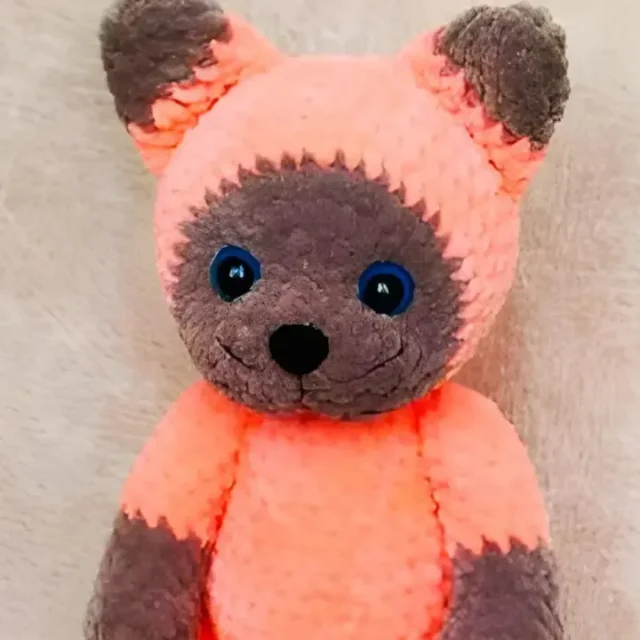
Plush amigurumi cat pattern with jointed limbs
Single crochet rounds build a dense, velvety cat amigurumi with posable jointed arms and legs.
- Skill
- Intermediate
- Time
- 4-6 hours
- Hook
- 4.0 mm
- Yarn
- DK
- Rounds
- 5
About this pattern
Worked in tight single crochet with a velvet-style yarn like Himalayas Dolphin Baby or YarnArt Dolce, the fabric comes out dense and low-piled under the hand, with almost no gaps between stitches. That tightness is what keeps stuffing from showing through the surface later, and it gives the piece a slight brushed softness rather than the crisp ridges you get from cotton. There is little stretch to it; the fabric holds its shape instead of giving.
The rounds build a head, body, and four limbs that close down through a run of decrease rounds, narrowing the stitch count from 36 to 18 before the opening shuts. Plastic doll joints at 15 mm let the finished arms and legs pivot at the body once sewn on, so the cat can be posed sitting, reaching, or sprawled rather than locked into one stance. Stuff firmly as each piece closes so the plush fabric stays smooth over the filling.
The swatch in numbers
- Rounds
- 5
- Parts
- 5
- Level
- Intermediate
- Time
- 4-6 hours
- Hook
- 4.0 mm
- Yarn
- DK
The yarn and the hook
Wire
- Himalayas Dolphin Baby or YarnArt Dolce
Hook size
- 4.0 mm or 3.5 mm
- 4 plastic doll seals ( 15 mm ) where you can sew your arms and legs to your body
- 10 mm safety nose
- Thin thread in thread tone to sew details together
- Black embroidery thread
- Refund
Tools
- 14 mm safety eyes
- Sewing needle and scissors
Stitches, spelled out
R round.
Tension and hand-feel
After working R3, count the stitches around the round and compare them to the number the pattern gives before moving on, since a plush yarn hides a missed decrease more easily than a smooth one.
If the count is off, unravel back to the last round you confirmed rather than adjusting later rounds to compensate, since the fabric should sit snug on the hook with no loose give at the stitch tops.
R 16
R 17
R 19
R 3
1 ms, 3 augm, 3 ms, 3 augm, 2 ms ( 18 )
R 6
7 ms, ( 1 ms, augm ) * 6, 7 ms ( 32 )
R 7: 7 ms, ( 2 ms, augm ) * 5, 10 ms ( 37 ) Insert safety eyes between R 5 and R 6 at a distance of 5-6 m from each other, the safety nose between R 2 and R 3.
Switch to the orange thread:
How the texture is built
- In R16, R17, and R19 the decreases land once every repeat (5 sc + dec, then 4 sc + dec, then 2 sc + dec), spacing the shaping evenly around the circle rather than stacking it in one spot, which keeps the closing curve rounded instead of pointed.
- The stitch loss between R16 and R17 is 6 stitches (36 to 30), matching the drop between R17 and R19 is 12 stitches (30 to 18) over the same six-repeat structure, so the narrowing speeds up as the round nears closed.
- Each of these three rounds removes exactly 6 stitches total no matter how many plain stitches sit between the decreases, which means the piece steps down in fixed 6-stitch increments on its way to the final closed round.
If you swap the yarn
| Cotton, DK weight | Gives crisper stitch definition and a firmer, less cushioned surface than the velvet yarn; drape turns stiffer and the fabric loses its brushed softness, so dropping to the 3.5 mm hook helps keep the stitches tight enough to hide stuffing. |
|---|---|
| Acrylic, worsted weight | Produces a lighter-in-the-hand fabric with more structure and easier washing, but the surface comes out smooth rather than plush, losing the low-pile texture the velvet yarn gives the finished cat. |
| Chenille-style polyester, light worsted weight | Stays closest to the original plush surface but the yarn can slip against itself mid-stitch, so working with the 4.0 mm hook and a slightly firmer tension keeps the fabric from loosening as rounds build up. |
Colorways
- Smoke and snow Keep R3 and R6 in a soft gray for the ears and body base, then carry white through the decrease sequence from R16 to R19 so the face narrows into a pale muzzle against the gray head.
Washing and blocking
Hand wash the finished cat in cool water, since the velvet-style fiber holds onto both water and heat longer than a smooth yarn.
Lay the piece flat to dry rather than hanging it, so the plastic joints and stuffed limbs do not pull the damp fabric out of shape.
Store away from anything that presses the pile flat for long stretches, and fluff the surface by hand after storage to bring the brushed texture back up.
When it does not look right
- A decrease round leaves a visible pucker instead of a smooth curve
- The decreases likely stacked close together instead of spreading evenly through the repeat; recount the repeat against R16, R17, or R19 and redo the round so each decrease falls once per six stitches.
- The stitch count comes up short or long after a decrease round
- A decrease was probably worked into one loop instead of two, or a plain stitch got skipped in the count; stop and count stitches against the pattern's 36, 30, or 18 before continuing further rounds.
- The fabric feels loose and stuffing shows faintly through the surface
- The hook is likely sitting at the larger end of the pattern's 4.0 mm to 3.5 mm range for a looser crocheter; drop to the smaller hook size to tighten the stitches and close the gaps.
Questions people ask
Why use plastic doll joints instead of sewing the limbs straight on?
The 15 mm plastic joints let the finished arms and legs pivot at the body rather than staying fixed in one position. That gives the cat posable limbs once the pieces are sewn together.
What are R16, R17, and R19 actually doing in the piece?
These three rounds close an open section down from 36 stitches to 18 through evenly spaced decreases. That steady narrowing shapes the rounded curve where the piece comes to a close.
Can yarn stand in for the black embroidery thread on the face?
The pattern calls for embroidery thread specifically because it stays thin enough for fine details like the mouth and whiskers. A full strand of yarn would sit too thick and bulky for that same line work.
New patterns, as they are filed
One short email when a batch lands, with the feel of each.