
15 rounds · filed under dense · 4 of them
Sweaters · added 2 Oct 2026
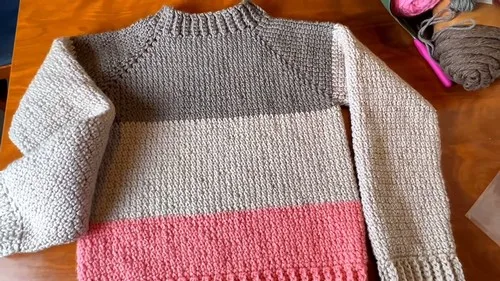
How to Crochet a Raglan Pullover With Ribbed Collar and Cuffs
Extended single crochet builds a dense, warm pullover body; ribbed BLO panels edge the collar, hem, and cuffs.
- Skill
- Intermediate
- Time
- 4-6 hours
- Hook
- 6 mm
- Yarn
- Bulky
- Rounds
- 12
About this pattern
Structurally this is a raglan pullover: a flat collar strip joins into a loop, gets picked up around for the yoke, then widens at four corners with V-stitch increases until the body is wide enough to stop shaping. Sleeves attach at the armpit and taper through paired decrease rounds toward the cuff. Once both sleeves join to the yoke's V-stitch corners, the body continues in plain ESC to whatever length is wanted, with color changes free to land on any round.
The swatch in numbers
- Rounds
- 12
- Parts
- 5
- Level
- Intermediate
- Time
- 4-6 hours
- Hook
- 6 mm
- Yarn
- Bulky
The yarn and the hook
Yarn
- Big Twist Jar (6 oz / 170 G)
Hooks
- 6 mm and 7 mm
Stitches
- sc, sl st, hdc, ESC, BLO, V-stitch, ESC-dec
Stitches, spelled out
ch chain; st stitch; sts stitches; sl st slip stitch; sc single crochetDense; hdc half double crochetDense; dec decrease; blo back loops onlyRidge; ESC extended single crochet; V-st V-stitchLace.
Tension and hand-feel
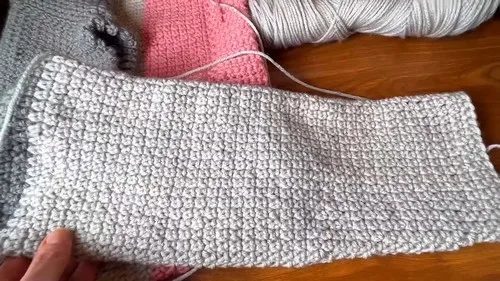
After round 1 of the yoke, lay the 56-sc collar join flat and check that it circles without cupping inward or rippling at the edge.
The Collar
Chain 7
The Yoke
Switch to 7 mm hook
Bottom Ribbing
With 7 mm hook, work 1 round sc around bottom edge
Sleeves
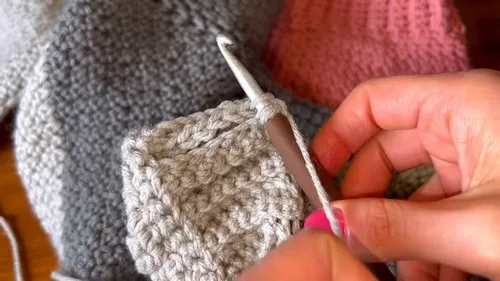
Attach yarn at armpit with 7 mm hook
Sleeve Ribbing
With 7 mm hook, work 1 round sc around cuff
How the texture is built
- The collar is worked flat over 56 rows of 6 sc each rather than in the round, because the BLO ridge needs two open edges to join; once joined with sl st and flipped inside out, those ridges sit vertically around the neckline instead of stacking horizontally.
- Raglan shaping lands at exactly four corners every round from round 2 through round 16, with a V-stitch at each corner and plain ESC filling the rest of the round, which is how the yoke widens in four directions without adding bulk across the front, back, or sleeve panels.
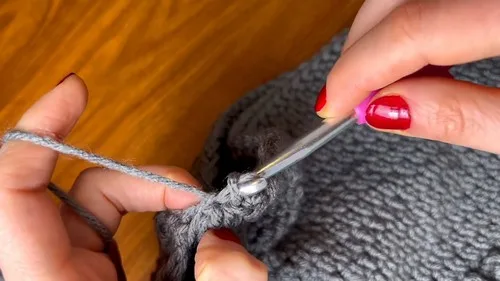
- Hem and cuff ribbing drops to the 6 mm hook and builds an 8-stitch BLO panel joined row by row with sl sts along the 7 mm sc foundation round, so the ribbing runs perpendicular to the edge it's attached to, the same construction trick used for the collar.
Putting the pieces together
If you swap the yarn
| super bulky acrylic-wool blend | Close in weight to the yarn this pattern is written for, so the 6 mm and 7 mm hooks stay as given; fabric comes out just as dense and warm, good for the same stuffing-free, structured ESC body. |
|---|---|
| worsted weight cotton blend | Needs a hook drop to roughly 5 mm and 5.5 mm to keep the stitch count honest; the finished pullover drapes softer and lighter, with less rib recoil at the collar and cuffs. |
| bulky alpaca blend | Keeps the 6 mm and 7 mm hooks workable but adds a soft halo over the ESC texture, so stitch definition at the V-stitch corners blurs slightly while the fabric gains extra warmth and drape. |
Colorways
- Sleeve Block Collar and yoke (rounds 1-16) in Color A, both sleeves in Color B worked solid through all 35 sleeve rounds, hem and cuff ribbing in Color C for a contrast band at every edge.
Washing and blocking
Hand wash in cool water and lay the sweater flat to dry, since the dense ESC body holds water longer than an open-stitch fabric and heavy hanging will pull the shoulders out of shape.
Reshape the ribbed collar and cuffs while damp, smoothing the BLO rows back into their vertical ridge pattern so the stretch recovers evenly instead of drying flared.
Fold rather than hang for storage, since the weight of the ESC yoke and sleeves can stretch the raglan lines over time if left on a hook or hanger.
When it does not look right
- The ribbing at the hem or cuffs flares
- The 6 mm ribbing panel is likely tighter or looser than the 7 mm sc foundation round it's joined to; recheck tension on the 8-stitch panel and go down a hook size if it's gapping.
- The yoke corners pucker instead of
- One of the four V-stitch corners was likely skipped or doubled during rounds 2-16; count stitches between corners each round and confirm all four increase at the same pace.
- The sleeve feels baggy just above the cuff.
- The ESC-dec at round 25 may not have pulled the stitch count down evenly; recount right after round 25 to confirm two fewer stitches than the rounds before it.
Close-ups
Questions people ask
Why is the collar worked flat instead of straight into a round?
The BLO ridge pattern needs two free edges to join into a loop, which is what gives the collar its stretch around the neckline. Once all 56 rows are done, the strip joins with sl st and flips inside out so the ridges face the right way.
How can you tell the raglan increases are placed correctly?
Each round from 2 to 16 should show exactly four V-stitch corners, with the ESC stitch count between them matching the previous round. If one side has more plain ESC than the opposite side, a corner increase was missed.
Can the sleeves be started before the yoke is finished?
No, sleeves attach at the armpit only after the yoke's 16 rounds of raglan shaping are complete, since the V-stitch corners they join to don't exist until that shaping is done.
New patterns, as they are filed
One short email when a batch lands, with the feel of each.