
19 rounds · filed under dense · 19 of them
Amigurumi · added 1 Oct 2026
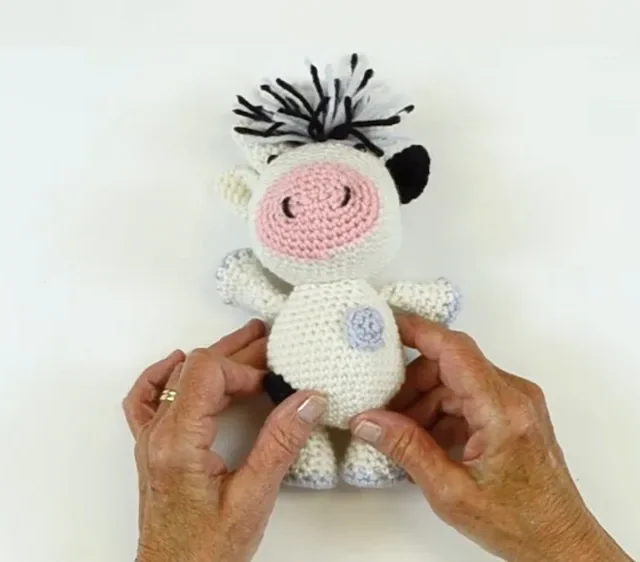
Single crochet amigurumi cow with oval head and legs
Single crochet worked tight builds a dense, round amigurumi cow with an oval head, legs, and domed body.
- Skill
- Intermediate
- Time
- 4-6 hours
- Yarn
- Worsted
- Rounds
- 19
About this pattern
Every round here runs on single crochet, worked tight and close so the fabric comes out stiff and opaque rather than drapey. With a 3.5 mm hook keeping the loops snug, the surface turns dense enough to block the fiberfill from shadowing through, and firm enough that the finished pieces hold their rounded shape without sagging or going soft at the edges.
The body builds from a small ring into a smoothly domed sphere, while the head and legs stretch sideways from an oval starting chain into a rounded snout and short tapered stumps. Stuff each piece firmly as you close it, then lay the parts side by side to plan where the head meets the body and how the legs will sit before sewing anything in place.
The swatch in numbers
- Rounds
- 19
- Parts
- 4
- Level
- Intermediate
- Time
- 4-6 hours
- Yarn
- Worsted
The yarn and the hook
Yarn
- 5 different areas to a hook, the head, the throat or the neck, the shaft, the thumb rest, and then there's the handle
- Fiberfill
- Plastic crochet hook
- Plastic needle
- Plastic eyes
- Instructions
- Scissors
- 3.5 millimeter hook
- Gauge
Stitches, spelled out
CH Chain; SC Single crochetDense; INC Increase (2 SC in the same stitch); DEC Decrease (SC in the next 2 stitches together); SL ST Slip stitch.
Tension and hand-feel
After round 1 of the body, check that the ring holds six tight single crochet stitches with no visible gaps between them.
If the fiberfill shows through or the ring looks loose and open, drop to a smaller hook or tighten your tension until the fabric turns dense enough to hide the stuffing completely.
Body
SC in the first SC, INC in the next SC, SC in the next 8 SC, INC in the next SC, SC in the next 8 SC, INC in the next SC, SC in the last 8 SC. (30 SC)
Head
Legs
For Round 6
SC, INC, SC, SC, SC repeat 6 times. (36 SC)
SC in each SC, DEC in the next 2 SC, SC in the next SC, DEC in the next 2 SC, SC in the next SC. (12 SC)
Step by step: SC in each SC, DEC in the next 2 SC, SC in the next SC. (6 SC).
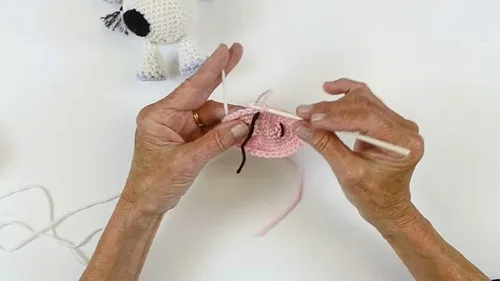
Step by step: SC in each SC. (30 SC) For Round 12: SC in each SC. (30 SC); SC in each SC, attach black yarn for nose. (30 SC).
SC in each SC, DEC in the next 2 SC, SC in the next 2 SC, DEC in the next 2 SC, SC in the next 2 SC, DEC in the next 2 SC, SC in the next 2 SC. (24 SC)
Step by step: For Round 15:.
SC in each SC, DEC in the next 2 SC, SC in the next SC, DEC in the next 2 SC, SC in the next SC, DEC in the next 2 SC, SC in the next SC, DEC in the next 2 SC. (18 SC)
SC in each SC, DEC in the next 2 SC, SC in the next SC, DEC in the next 2 SC, SC in the next SC. (12 SC)
SC in each SC, DEC in the next 2 SC, SC in the next SC. (6 SC) For Round 18: SL ST in the first SC, fasten off and weave in tail.
How the texture is built
- The body begins from a snug six-stitch ring (chain 2, six single crochet) and gains exactly six stitches every round through evenly spaced increases, producing a smoothly domed round form rather than a flat disc.
- The head and legs instead start from a chain-6 foundation worked with three or four stitches into each end chain, building an elongated oval base before any increases begin, which stretches the starting round lengthwise and sets up a tapered, snout-like profile from the first row.
- In the head and legs, the gap between increase points grows by one plain stitch each round (four, then five, then six), keeping the six increase columns stacked directly on top of each other round after round, so fullness lands in the same six spots and rounds the shape out evenly as it grows.
If you swap the yarn
| Cotton, worsted weight | Produces a stiffer, less fuzzy single crochet fabric that holds the ring and oval bases crisply; keep the 3.5 mm hook as given and pack stuffing a touch firmer, since cotton has less natural bounce than a synthetic fiber. |
|---|---|
| Acrylic, DK weight | Makes a thinner, more pliable fabric that softens the rounded body slightly, so size down to around a 3.0 mm hook to keep stitches tight enough to hide the fiberfill, and expect a smaller finished piece overall. |
| Wool-blend, bulky weight | Thickens every round fast and loosens the gauge, so size up the hook only if stitches feel too tight to work, and use less fiberfill than usual since the heavier yarn already adds body on its own. |
Colorways
- Warm tan and cream Work the body and both legs in a warm tan, then change to a lighter cream for the head only, so the oval snout reads as a paler muzzle against the darker body.
Washing and blocking
Hand wash the finished cow in cool water; a synthetic worsted yarn and the polyester fiberfill inside both resist shrinking but can mat if run through a hot machine cycle.
Lay the piece flat to dry rather than hanging it, since a damp amigurumi body holds water in the fiberfill and can stretch out of its round shape if left dangling.
Reshape the domed body and legs by hand while still slightly damp, pressing them back into their rounded form, then store the finished piece out of direct sun so the tight single crochet fabric does not fade unevenly.
When it does not look right
- The head looks lopsided instead of a smooth oval.
- This happens when the 15 stitches from the chain-6 oval base are not split evenly between the two ends; recount the stitches after round 1 before working any increases, since an uneven split throws off every later round.
- A piece's stitch count drifts above the number given at the end of a round.
- An extra increase has likely slipped into the wrong stitch; check the total against the pattern's running counts (6, 12, 18, 24, 30 for the body) at the end of every round so a stray increase gets caught immediately.
Close-ups



Questions people ask
Why does the head start with a chain of 6 instead of a ring like the body?
The head and legs use a short foundation chain worked with multiple stitches into each end chain, producing an oval first round instead of the body's tight circle. That oval shape carries through the increases, giving the head and legs a longer, more tapered profile than the rounded body.
How many stitches should each piece measure by the last sample round shown?
The body's sample rounds build up to 30 single crochet by round 5, while the head and legs both reach 24 single crochet by round 4. Checking your count against these numbers after each round is the fastest way to catch a missed or extra increase.
Can the plastic eyes be swapped for a different size of safety eyes?
Yes, as long as the eye posts still anchor firmly against the dense single crochet fabric of the head once the washers are attached. A larger eye may need its backing seated between an earlier or later round depending on how wide the head has grown by that point.
Are the rounds worked continuously or joined and turned?
The stitch counts rise cleanly from round to round with no join or turn mentioned anywhere, which points to continuous spiral single crochet throughout. Keep a stitch marker in the first stitch of each round so you can track exactly where one round ends and the next begins.
New patterns, as they are filed
One short email when a batch lands, with the feel of each.