
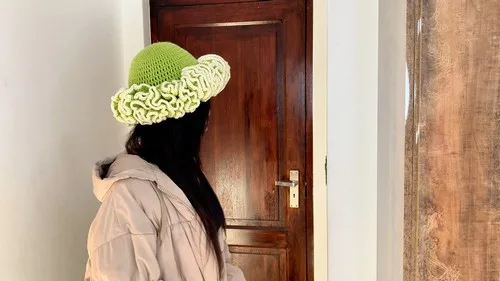
12 rounds · filed under drape · 10 of them
Hats · added 26 Sep 2026
Double crochet ruffle brim hat with a stacked edge
Double crochet builds a firm crown, then loose DC ruffles stack into a soft, springy brim edge on this hat.
- Skill
- Intermediate
- Time
- 4-6 hours
- Hook
- 3.5 mm
- Yarn
- DK
- Rounds
- 12
About this pattern
The crown of this hat sits dense and springy under your fingers, a direct result of working DC round after round with a 3.5 mm hook on DK weight yarn. Each double crochet stacks taller and looser than a single crochet would, so the fabric has enough give to stretch over your head without losing its shape once it's off. Run a thumb across a finished round and you can feel the ridges the turning chains leave, a faint corduroy texture rather than a smooth knit-like surface.
Once the crown rounds finish increasing, the piece becomes a shallow dome that fits a head like a cap, not a slouchy bag. From there the ruffle rounds flare outward in wide, loose DC clusters, three or four stitches worked into every stitch below, so the brim stands away from the head in stacked frills instead of hugging the skull. Wear it with the ruffle tipped up off the face or left to fall forward over the brow, since the fabric holds either angle once set.
The swatch in numbers
- Rounds
- 12
- Parts
- 2
- Level
- Intermediate
- Time
- 4-6 hours
- Hook
- 3.5 mm
- Yarn
- DK
The yarn and the hook
- 200g Main Color (DK weight yarn)
- 50–60g Contrast Color (DK weight yarn)
- Hook 1: 3.5 mm
- Hook 2: 4 mm
Stitch Used
- Double Crochet (DC)
Stitches, spelled out
DC double crochetDrape; SC single crochetDense; Ch chain; St stitch; Sts stitches.
Tension and hand-feel
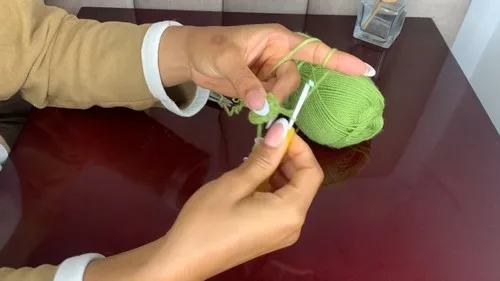
After Round 1 of the crown, lay the tiny worked circle flat and check that the 12 DC lie snug with no gaps and no cupping at the center; if the disc buckles into a cone, your DC are too tight and a slightly larger hook will loosen the fabric back to a flat lie.
If instead the disc ripples with excess fullness in the middle, your stitches are too loose for the 3.5 mm hook, so size down and recheck after the next round.
Crown
Worked with Main Color and the 3.5 mm hook.
Ruffle
Ruffle rounds are worked attached to the Brim row of the Crown.
Switch to the 4 mm hook starting with Ruffle 2.
Attach Contrast Color yarn for the Ruffle Trim.
How the texture is built
- The increase pattern spaces new stitches one stitch farther apart each round (2 DC per stitch in Round 2, then 1-then-2 in Round 3, then 1-1-then-2 in Round 4), which is what keeps the crown flat and disc-shaped instead of cupping as it grows from 12 to 72 stitches.
- The ruffle is worked in the round, not flat, but each round multiplies every stitch by 3 or 4 DC, so even though it's joined and continuous, the stitch count explodes fast enough to force the fabric outward into a frill rather than lying flat like the crown.
If you swap the yarn
| Wool-blend DK | Holds the ruffle rounds open with more spring than a plant fiber, so the frills stand up on their own edge; stick with the 3.5 mm and 4 mm hooks as given since wool DK behaves close to a standard worsted-adjacent gauge. |
|---|---|
| Cotton DK | Drops drape rather than bounce, so the ruffle will fall in softer waves instead of standing proud; sizing up half a hook step on the ruffle rounds helps keep the frills from curling in tight on themselves. |
| Acrylic DK | Keeps the crown lightweight and the ruffle rounds crisp with sharp stitch definition, closest in behavior to the gauge the pattern was written for, so the 3.5 mm and 4 mm hooks need no adjustment. |
Colorways
- Split brim Keep the main color through the crown and Ruffle 1, then swap to the contrast color for Ruffle 2 and Ruffle 3 as well as the Trim, so the entire flared portion of the brim contrasts with the fitted dome of the crown.
Washing and blocking
Hand wash in cool water if the yarn is wool or a wool blend, since machine agitation can felt the dense DC crown into a stiffer, shrunken fabric.
Lay the hat flat to dry with the ruffle rounds gently fanned out, so the stacked DC frills dry in their flared shape instead of drying flattened under their own weight.
Store flat or stuffed lightly with tissue rather than folded, since folding across the ruffle rounds can crease the stiffer DC stitches into a permanent line.
When it does not look right
- The crown cups upward like a bowl instead of lying flat
- The increases in one of the early rounds were skipped or worked too far apart, pulling the center in; check the stitch count against the number given for that round and add increases evenly to bring it back to a flat disc.
- The ruffle lies flat against the head
- The 3 or 4 DC increase in each stitch was likely worked as fewer stitches per stitch, so the round didn't gain enough fullness; recount and rework the round at the full multiplication given for that ruffle round.
- The join at the end of each round looks twisted or offset
- The slip stitch closing the round was worked into the wrong stitch, shifting the round's start point; count back to the first DC of the round before joining to keep the spiral of joins stacked directly above each other.
Close-ups
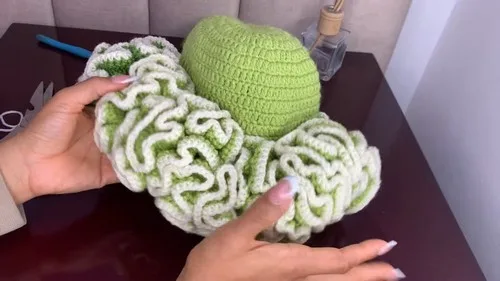
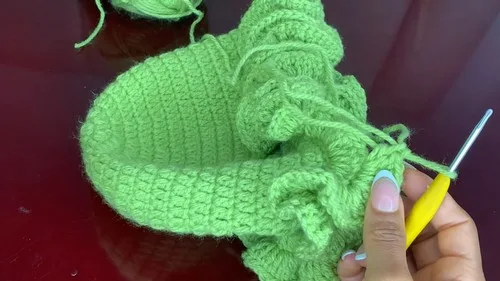
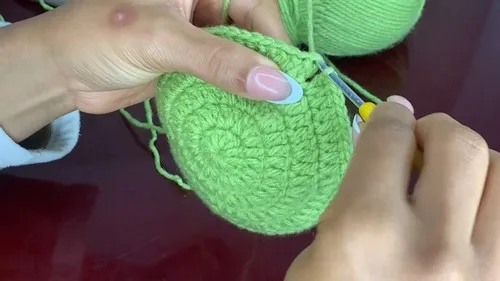
Questions people ask
Can the ruffle rounds be worked in the same color as the crown?
Yes, the contrast color is only called for on the Ruffle Trim round, so working every round before that in the main color leaves a single-color hat with just a thin trim line at the edge. This keeps the fabric's texture as the main visual interest rather than a color break.
Why does the crown need 8 rounds before the ruffle starts?
The first 6 rounds each add a layer of evenly spaced increases that grow the disc from 12 stitches up to a full 72-stitch circumference, then Rounds 7–15 and the single crochet brim round work even, without further increasing, to build the crown's depth. Starting the ruffle before this depth is complete would leave the crown too shallow to sit properly on the head.
Does the fabric stretch enough to fit different head sizes?
The dense DC crown has some natural give from the yarn itself but holds its dome shape rather than stretching significantly larger. If a looser fit is needed, working the crown rounds with a slightly larger hook than the 3.5 mm specified will open the stitches for more stretch.
New patterns, as they are filed
One short email when a batch lands, with the feel of each.