
13 rounds · filed under drape · 5 of them
Garments · added 15 Sep 2026
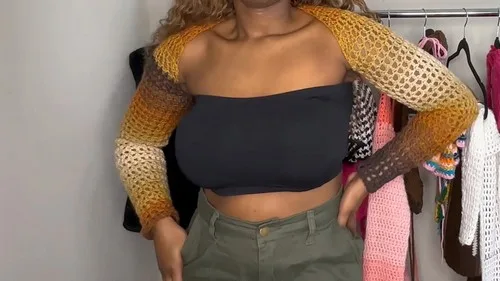
Cozy double crochet bolero using just one stitch repeat
Double crochet and chain-1 spaces build an open, drapey mesh for a simple, sleeved bolero.
- Skill
- Intermediate
- Time
- 4-6 hours
- Yarn
- Worsted
- Rounds
- 10
About this pattern
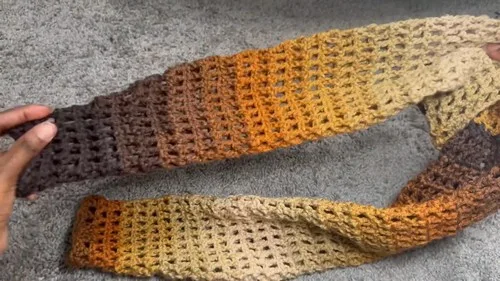
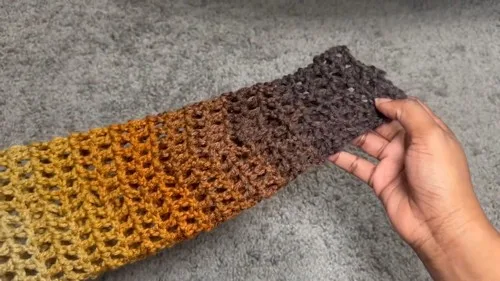
Under the hand, this bolero has give in every direction. Double crochet worked with a chain-1 between each stitch leaves open gaps down the whole body, so the fabric flexes instead of holding a stiff line. It's a single stitch repeated row after row, which means the surface stays even and the eye doesn't catch on pattern breaks, only on the open mesh itself.
The body starts as a flat rectangle worked back and forth, then gets folded and seamed at the shoulders to form armholes, with sleeves picked up and worked in the round from there. Wear it open over the shoulders as a light layer, or treat it as a topper for a sleeveless dress where the arms need covering but the torso doesn't need warmth.
The swatch in numbers
- Rounds
- 10
- Parts
- 4
- Level
- Intermediate
- Time
- 4-6 hours
- Yarn
- Worsted
The yarn and the hook
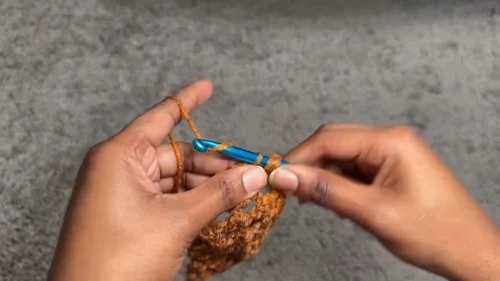
- Red Heart Super Saver yarn in Latte Stripe
- K-size crochet hook
Tension and hand-feel
After Row 3 of the body, lay the piece flat and check that the double crochet columns line up straight with even chain-1 gaps between them, rather than leaning or bunching to one side.
Body of the Bolero
Sleeve
Make 2Edging
Second Sleeve
How the texture is built
- The body increases only at the end of Row 2 rows, which angles the two front panels outward while the straight rows (Row 3) between them keep the back section from widening at the same rate.
- The body is worked flat rather than in the round because it needs to fold at the shoulder line to form armholes; a tube worked in rounds couldn't be shaped this way with a single stitch repeat.
- The sleeve join folds the body panel and works into the third chain of a foundation chain, which turns a flat seam edge into a round without a visible seam line at the underarm.
Putting the pieces together
If you swap the yarn
| Acrylic, worsted weight | Closest match to the original; holds the chain-1 gaps open with minimal stretch, and a K hook stays correct. |
|---|---|
| Cotton blend, worsted weight | Adds weight and drops drape lower on the body since cotton has less bounce than acrylic; size down to a J hook to keep the mesh from sagging. |
| Wool blend, worsted weight | Softens the hand and adds stretch recovery to the chain-1 spaces, but the fabric will felt slightly with wash agitation, so a gentler laundering routine matters more. |
Colorways
- Tonal wash Use one skein of a self-striping yarn like Latte Stripe throughout the body, both sleeves, and the edging so the stripe sequence reads as a single continuous gradient across the whole piece.
Washing and blocking
Machine wash the finished piece on a gentle, cool cycle since Super Saver is acrylic and holds up to regular washing without shrinking.
Lay flat to dry rather than tumble drying on high heat, which can flatten the open double crochet mesh and dull the stripe pattern.
Reshape the body and sleeves by hand while damp to keep the increase-shaped front panels sitting evenly, then store folded rather than hung to avoid stretching the chain-1 gaps out of shape.
When it does not look right
- The front panels flare out too sharply
- The increases at the end of Row 2 rows are adding stitches faster than the body length grows; check that increases happen only every other row (Row 2, not Row 3) as the pattern specifies.
- The sleeve puckers or twists where it joins the body
- This usually means the fold placement or the third-chain insertion point in Round 1 of the sleeve was off by a stitch; unpick to the join and re-count from the fold before continuing.
- The mesh looks tight and boardy instead of open and flexible
- The chain-1 spaces between double crochets are likely being worked too snugly; loosen tension on the chain stitches specifically, since the double crochets themselves can stay at normal tension.
Close-ups
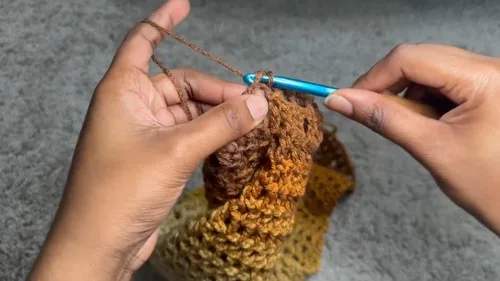
Questions people ask
Can this bolero be resized beyond the four given sizes?
Yes, since the increases only happen at the end of even rows, you can extend the body past Row 19 for a larger size, just keep ending on an odd-numbered row with no increase so the shaping stays even.
Why does the sleeve pattern mention different starting chain counts?
Round 2 of the sleeve adjusts the chain count (9 for small, 11 standard, 13 for large, 15 for XL) to set the arm width before working in the round, so the sleeve circumference matches the body size chosen.
Does the open mesh fabric run or unravel easily at the edges?
The single crochet edging round closes off all raw edges and chain spaces, so once that round is complete and fastened off, the mesh does not run or loosen further.
Is blocking necessary for this piece?
Blocking is optional but recommended if the mesh looks uneven after seaming, since gentle blocking evens out the chain-1 gaps across the body and both sleeves for a more uniform drape.
New patterns, as they are filed
One short email when a batch lands, with the feel of each.