
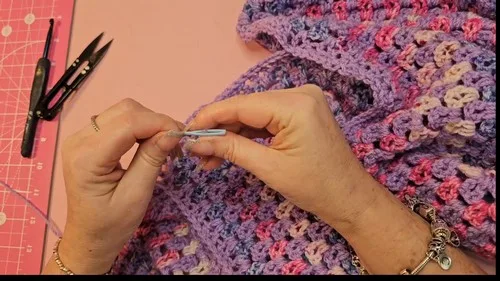
7 rounds · filed under lace · 3 of them
Garments · added 15 Sep 2026
V-stitch hexagon cardigan with open lattice texture
V-stitch builds an open, airy lattice with give in every direction. Two hexagons seam into a light cardigan.
- Skill
- Intermediate
- Time
- 4-6 hours
- Hook
- 5 mm
- Yarn
- DK
- Rounds
- 3
About this pattern
Under your hand this fabric reads open and airy, full of small diamond gaps that let light through. The V-stitch does the work: two double crochets angled apart around a Chain 1 leave a gap at the center of every stitch, and stacked round after round that gap becomes a lattice with real give. Pull the edge gently and it stretches sideways before it stretches long, so the hexagon panels move with your shoulders rather than fighting them.
Each hexagon grows flat from a tight center ring outward, picking up an extra V-stitch on every side with every round until it reaches full size. Two identical panels come off the hook this way, then get folded at their points and seamed along the shoulders and armholes, joined again down the back, and finished with a single crochet edge that runs the whole way around to keep the lattice from curling at the hem and front edges.
This pattern is easy to customize: you can adjust the size or length as needed, whether you prefer a snug fit or something oversized, making it a fun, customizable make for beginners and experienced crocheters alike.
The swatch in numbers
- Rounds
- 3
- Level
- Intermediate
- Time
- 4-6 hours
- Hook
- 5 mm
- Yarn
- DK
The yarn and the hook
Yarn
- King Cole Double Knitting Splash and solid lilac acrylic
- Hook: 5 mm
Other
- Snippers and darning needle
Stitches, spelled out
V-stitch Double Crochet, Chain 1, Double Crochet into the same spaceLace.
Tension and hand-feel
After Round 3, lay the hexagon flat and check that the six corner Chain-2 spaces sit at even distances from the center point, since an uneven spread here means the panel will pull sideways once it grows larger.
If the fabric feels stiff and the V-stitch gaps look pinched shut rather than open, go up in hook size; if the diamonds gape wide and the hexagon buckles instead of lying flat, drop down a size.
V-Stitch Hexagon
Make 2Change colors each round throughout, carrying the unused yarn.
You will need two identical hexagons for this cardigan.
How the texture is built
- Each hexagon starts as a tight ring of 6 V-stitches worked into a chain circle, which is what gives the corner points their sharp angle rather than a rounded edge.
- The extra V-stitch added to every side each round is what keeps the hexagon lying flat rather than cupping, since a plane needs a fixed number of added stitches per round to hold six straight edges.
- The color-change slip stitch at the end of every round means each round carries a single color across its own stitches, so the carried yarn sits invisibly inside the work rather than showing through the open lattice.
Putting the pieces together
If you swap the yarn
| Acrylic DK, single solid color | Drops the two-color carry entirely, so every round is quicker to work and the fabric stays exactly as light and stretchy, but the hexagon loses the ring pattern the color change creates. |
|---|---|
| Cotton DK | Produces a heavier, less stretchy hexagon with crisper stitch definition around each V, so the lattice gaps hold their shape more firmly but the finished cardigan drapes stiffer against the body. |
| Wool-blend worsted | Needs a 5.5mm or 6mm hook to keep the gauge open, gives the fabric more loft and warmth, and softens the diamond gaps slightly since the fiber has more bounce than acrylic. |
Colorways
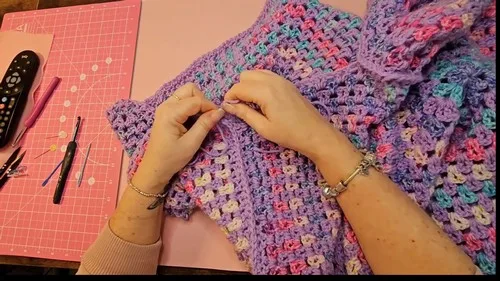
- Mirrored panels Give one hexagon a lilac center with Splash outer rounds, and the second hexagon a Splash center with lilac outer rounds, so the two panels land as color negatives of each other once seamed into the cardigan.
Washing and blocking
Hand wash the acrylic panels in cool water, since machine agitation can felt the carried strands where two colors sit close together inside the stitches.
Lay the cardigan flat to dry rather than hanging it, because the open V-stitch lattice has enough stretch that a wet hexagon will sag out of shape on a hanger.
Store folded rather than hung, and smooth the corner points flat by hand before folding so the hexagon shape holds through storage.
When it does not look right
- The hexagon cups or curls at the edges
- A round is missing its extra corner V-stitch on one or more sides; count the V-stitches per side against the round below and add the missing one before continuing.
- The two colors show through faintly
- The carried yarn is being pulled too tight across the back of the stitches; carry it with a little slack so it lies flat inside the fabric rather than puckering it from behind.
- The seamed shoulder sits crooked or the armhole gapes open.
- The two hexagon points were not matched corner-to-corner before single crocheting the seam; unpick a few stitches and realign the points so the seam line runs straight along matching edges.
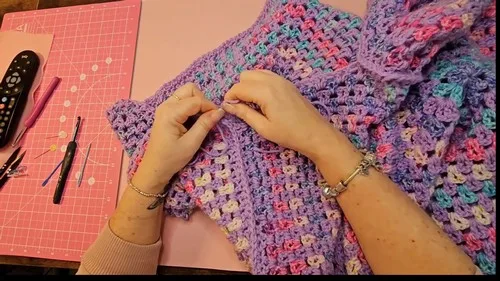
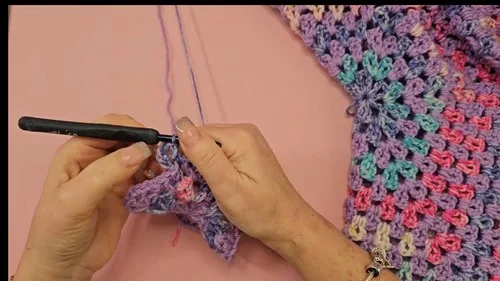
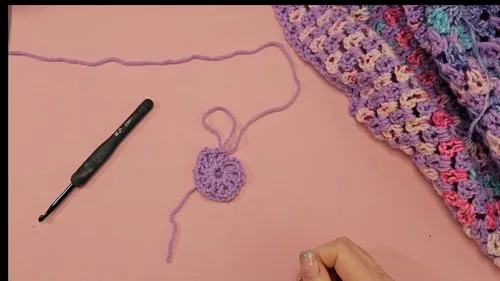
Close-ups
Questions people ask
Why does the hexagon need to grow by one V-stitch per side each round?
A flat hexagon has six straight sides, and each side needs one more stitch than the round before it to keep the edges from pulling in or flaring out. Skipping this increase is what makes a hexagon dome instead of lying flat.
Does the V-stitch fabric need lining or backing?
No, the lattice is meant to stay open; the double crochet pairs give enough body that the fabric holds its shape without backing. A lining would flatten the texture the V-stitch is built to show.
How much does the finished lattice stretch?
The Chain-1 gap in every V-stitch gives the fabric noticeable sideways give, more than a solid double crochet fabric would have. It moves easily across the body but holds its length well from hem to shoulder.
Can the two hexagons be worked in different color orders?
Yes, since each hexagon is worked separately before seaming, nothing requires the color changes to match between them. Working them as mirrored color negatives is a straightforward way to vary the look without changing the stitch pattern.
New patterns, as they are filed
One short email when a batch lands, with the feel of each.